The VexBank's HDI
Index
-- Introduction
-- HDI by Government Type
-- GDP pp by Government Type
-- Population by Government Type
-- Explaining Government Type
The Vexillium Bank was established, in part, to help nations emerging into the world
from under tyranny to develop their economic potential for the benefit of their people.
Part of any economic assessment of a nation must involve a statement of the economic
status of the nation. However, the Bank found that more often than not, only Gross
Domestic Product (GDP) is used for this measure, which provides an unfair measure of
the well-being of a people.
 While effective at measuring the size of an economy, GDP measurements
make no attempt to describe the quality of the economy. How well distributed is
the wealth? Is the money being hoarded as jewelry in the vaults of the King? Etc..
While there are measures, such as the Gini coefficient, for wealth distribution, the
Bank concluded that a measure of the development of a nation was required. Thus, it
developed the Human Development Index.
While effective at measuring the size of an economy, GDP measurements
make no attempt to describe the quality of the economy. How well distributed is
the wealth? Is the money being hoarded as jewelry in the vaults of the King? Etc..
While there are measures, such as the Gini coefficient, for wealth distribution, the
Bank concluded that a measure of the development of a nation was required. Thus, it
developed the Human Development Index.
<Tech> ...an idea freely stolen from the UN of Earth. Or was it the World Bank?
Where's this "Earth" you say? </tech>
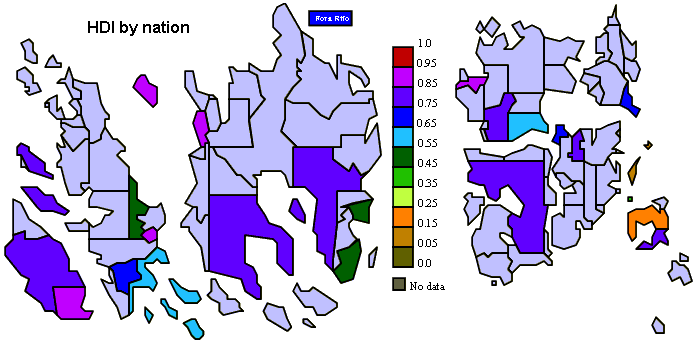
The Vexbank HDI takes three core measurements: (a) the price-parity GDP per person
in; (b) the educational standard; and (c) the duration of the average life of a citizen.
By these three measurements, the HDI is reflecting the economic, educational and health
status of a nation.
HDIs have been calculated for numerous nations of the Vexillium, as listed below,
and these results have been charted and compared against the type of government of the
nation.
HDI vs Government Type
 We allocated nations into one of ten government types, five democratic and five
autocratic or bureaucratic then took the average HDI of those nations and found that
the best government type for economic development is, perhaps not surprisingly, Liberal
Democratic or Libertarian Democratic.
We allocated nations into one of ten government types, five democratic and five
autocratic or bureaucratic then took the average HDI of those nations and found that
the best government type for economic development is, perhaps not surprisingly, Liberal
Democratic or Libertarian Democratic.
Vexillium's 15 Liberal Democratic nations averaged a HDI of 0.791, while the single
Libertarian Democratic (Listonia) scored a HDI only fractionally less, 0.788. While it
might be an easy conclusion to make that Liberal Democracy, according to this study,
makes a nation rich, readers would be wise to note the statisticians credo: Correlation
is not causality.
Did these nations develop high HDIs because they are Liberal Democratic, or did
they become Liberal Democratic because they have high HDIs? Without a historical series
for each nations' HDI, this question cannot be answered, but the correlation between
HDI and Liberal Democracy is interesting nonetheless, leaving numerous interesting
questions.
In third place is Socialist Democracies, such as Armatirion and Solelhada,
which tend to boost their HDI scores, which average 0.721, more with greater emphasis
on health care and education than by having high GDPs per person. This is demonstated
with the chart below of GDP per person by government type. This government type is
followed closely by the Semi-Liberal Democracies, which means Lendosa's 0.813
is dragged low by Rovens' 0.499.
Constitutional and full Monarchies follow with averages of 0.516 and 0.469
respectively, before the two Theocratic and one socialist dictatorships with average
HDIs of 0.302 and 0.110 respectively.
GDP per person vs Government Type
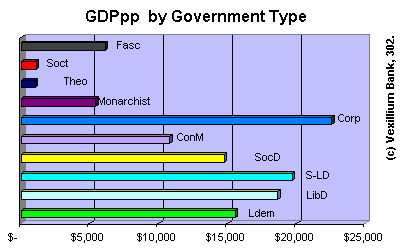 The HDI scores can be broken down into their component factors, and to the right is a
chart of GDP per person by government types, taking the aggregate GDP of all the nations
of that type and dividing by their total populations.
The HDI scores can be broken down into their component factors, and to the right is a
chart of GDP per person by government types, taking the aggregate GDP of all the nations
of that type and dividing by their total populations.
Interestingly, it the Corporate Bureaucracies that hold a substantial lead over
all other government types with an average of C22,568 per person. This reflects the high
GDP per person of the Burovian commonwealth (as no figures are available for the TD Corp.).
Liberal Democracies trail behind even Libertarian and semi-Liberal democracies in
the GDP stakes. Listonia's C18,635 per person and the C22,394 GDP per person of Lendosa
(weighed down by the C4,261 of Rovens), give high average GDPs, higher than the average
C15,534 for Liberal Democratic states. The fifteen liberal democracies may include economic
power-houses of Davenport, Bowdani, Wesmerite and Estontetso, plus numerous smaller
wealthy states like Aethelnia, Porto Capital, Cimera, Vingarmark and Kiltanland, but it
is weighed down by several poorer nations, ranging from Rovens and Utania to Eastern
Delgamia and Ansonia.
Socialist Democracies have a similar average GDP per person of C14,754, but
constitutional Monarchies trail at only C10,783. However, the Monarchies and dictatorships
trail the worst with C5,417 for the single monarchy on record (Feniz) and C5,416 for the
five dictatorships combined.
Educational vs Government Type
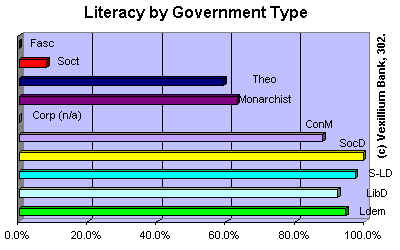 Taking another component of the HDI, literacy, Vexbank studies show that the results clearly
show that democratic nations exceed non-democratic nations in literacy tests. Vexillium's 17
Democratic nations (with literacy records) have an average literacy, weighted by population,
of 97.2%, with the lowest score being Rovens' and Ordlands' 85%.
Taking another component of the HDI, literacy, Vexbank studies show that the results clearly
show that democratic nations exceed non-democratic nations in literacy tests. Vexillium's 17
Democratic nations (with literacy records) have an average literacy, weighted by population,
of 97.2%, with the lowest score being Rovens' and Ordlands' 85%.
In contrast, literacy averages 49.2% with extreme scores in communist UPRMI of 8% in
contrast the Theocratic Couatl's 90% literacy.
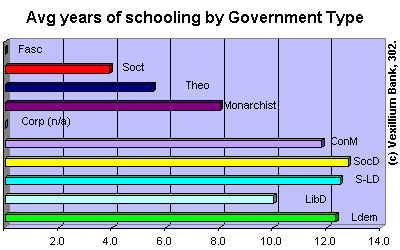 The second HDI-contributing education factor is the average number of years of school attended
by a nation's adult citizens. Once again, there is a clear delineation between democratic
countries and non-democratic.
The second HDI-contributing education factor is the average number of years of school attended
by a nation's adult citizens. Once again, there is a clear delineation between democratic
countries and non-democratic.
Democratic nations' citizens average 12.5 years of schooling (population weighted)
compared to the 6.0 years for non-democratic nations. And, like literacy tests, there is
little variance in schooling years between the various types of democratic governments, or
nations, with Solelhada averaging 8 years, and Cruisana 14.5 years.
Non-democratic types of government vary between an average for Monarchies (only Feniz
has supplied these numbers) of 8 years, to the socialist dictatorship, UPRMI, 3.9 years.
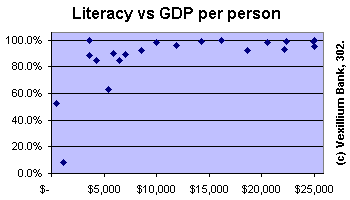 Once again, while correlation does not represent causation, it is tempting to say
that democratic nations have a commitment to education and literacy because of their
being governed by the people. However, an cursory examination of educational standards
versus GDP per person shows that there is perhaps a another explanation for low educational
standards in these non-democratic, poorer nations.
Once again, while correlation does not represent causation, it is tempting to say
that democratic nations have a commitment to education and literacy because of their
being governed by the people. However, an cursory examination of educational standards
versus GDP per person shows that there is perhaps a another explanation for low educational
standards in these non-democratic, poorer nations.
Regretably, the sample size is too small to make a stronger claim, but there is a
trend in the chart that shows falling literacy with falling GDP per person. This should not
be unexpected: with a smaller economy, poorer nations have more subsistance workers, and
fewer people they can allocate to service jobs, such as teaching, let alone spare their
teens and youth for education.
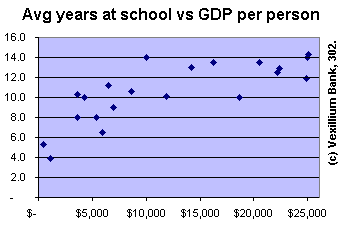 The same trend shows up again, but this time more pronounced, when years of education are
plotted against GDP per person. More clearly, there is a trend: poorer nations have less
schooling.
The same trend shows up again, but this time more pronounced, when years of education are
plotted against GDP per person. More clearly, there is a trend: poorer nations have less
schooling.
However, this is not to let poor, and invariably non-democratic nations off the
hook -- their restrictions upon their people and their freedom may be a strong cause for
poor economic development, and thus for educational standards. At the very least, their
autocracy will be a strong dissuasion for foreign, even domestic, investors that will
spend the money to upgrade the economic capacity of the population.
Health standards vs Government Type
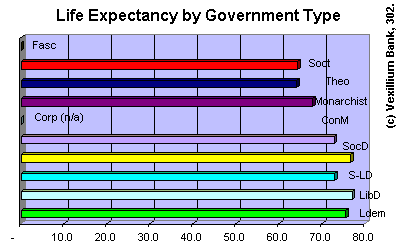 Lastly, the same plot is performed for health standards, measured by the longevity of
nations' citizens against government type, and below that by GDP per person. Once more,
there is little variation between democratic government types, and overall, citizens of
democratic nations live 75.6 years.
Lastly, the same plot is performed for health standards, measured by the longevity of
nations' citizens against government type, and below that by GDP per person. Once more,
there is little variation between democratic government types, and overall, citizens of
democratic nations live 75.6 years.
Citizens in non-democratic nations, however, live on average ten years less than
democrats, living only an average of 65.4 years.
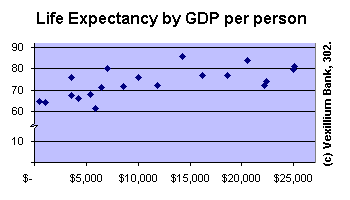 Measuring life expectancy against GDP per person shows that, as one might expect by now,
falling GDP per person leads to a shorter life.
Measuring life expectancy against GDP per person shows that, as one might expect by now,
falling GDP per person leads to a shorter life.
However, it must be emphasised that in each of the plots against GDP per capita,
there has been a great deal of variation and no clear-cut relationships can be drawn.
There is, ultimately, only a correlation between the figures, but with local factors,
and, arguably, government type, also playing a significant part in the health, wealth
and education of a nation's citizens.
GDP, population aggregates vs Government Type
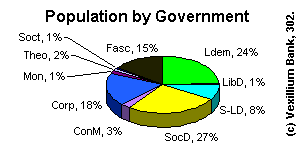
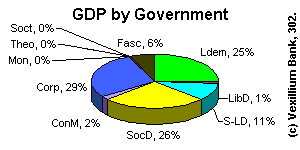 Finally, showing aggregate results for GDP and population by government type give a
"feel" for Vexillium's nations. Clearly, while there may be a large number of Liberal
Democratic nations, the Corporate Bureaucracies have the largest economies in the
world, and socialist democracies have the largest numbers of people in the world.
Finally, showing aggregate results for GDP and population by government type give a
"feel" for Vexillium's nations. Clearly, while there may be a large number of Liberal
Democratic nations, the Corporate Bureaucracies have the largest economies in the
world, and socialist democracies have the largest numbers of people in the world.
However, undeniably, democracies dominate the globe, which is a very significant
change from the years before the revolutions that swept Vexillium in the late nineties.
Those days of nationalist dictatorships, like Northern Gronk and Guwimith, appear to
be waning. With them, the poverty of their economic systems is also waning with them.
 Of course, it is worth noting that statistics like GDP per capita and years of education
per adult have not been developed within the past few short years of democratic
government. This point is key, because it means that high levels of education, high
life expectancy and high levels of national wealth have been developed in many
nations before they were democratic.
Of course, it is worth noting that statistics like GDP per capita and years of education
per adult have not been developed within the past few short years of democratic
government. This point is key, because it means that high levels of education, high
life expectancy and high levels of national wealth have been developed in many
nations before they were democratic.
For example, the people of Cimera have, on average, high levels of education,
good life expectancy and high GDP per person. Yet, it was only a few short years ago
that they were under the Meritean Empire, and developed under Imperial noses this
high HDI score (0.934).
Therefore, it is worth considering that nations' high HDI scores may not reflect
so much their being liberal or otherwise democracies, but may be a reflection of the
fact that well-educated and wealthy people demand freedom and overturn autocratic
governments.
Method
This study has been compiled with the grateful assistance of the nations of the Vexillium
who have supplied the raw data. The VexBank welcomes more submissions from nations to
help round out the study further.
The raw data used in this study is Population, GDP, literacy for persons over 15
years, average number of years in school for the average adult, and average life
expectancy.
In summary, the HDI has been a very good indicator for
Definitions of Government Type
This listing is less about systems of government as it is about the various
philosophical forms of government. Socialism, fascism and Burovianism are philosophical
ideas that have been implemented into forms of government, but they are not uniform
in terms of their specific implementation; For example, what precise rights their
citizens have, the structure of their governments, etc...
These government types are those forms of government, making no distinction,
for example, between first-past-the-post and proportional representation democracies
-- both are democratic, in that they permit the people to choose the government of
the day.
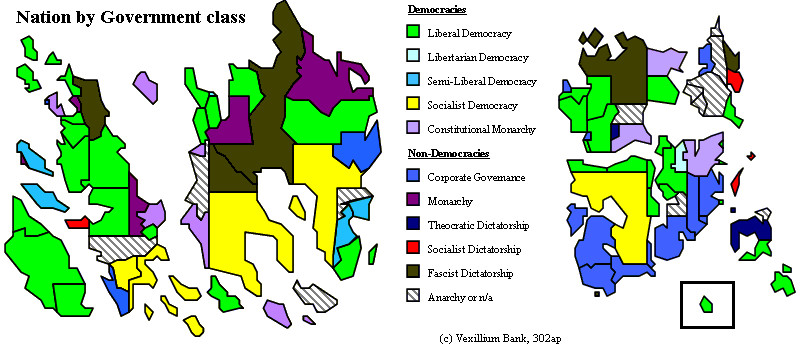
- Liberal Democratic is a blend of two concepts or ideas for government:
democracy and Liberalism. Democracy is reasonably straight-forward: the people
ultimately govern. The Bank has chosen to further simplify this definition adding
"by choosing their government". Burovianism might be considered democratic in that
the people govern.
Liberalism, for the sake of this analysis, is the idea that the people
are free from their governments. Governments should stay out of the lives of their
citizens, says Liberalism, government is the servant of the people, and should be
as open and transparent as possible.
- Libertarian Democratic is basically the same as Liberal Democratic, but
that it emphasises the Liberal more, keeping government out of almost all
private citizen affairs, minimising the role of government and emphasising the role
of the private citizen. Libertarians might argue that they, not modern-Liberal
Democrats, are the true Liberals. Listonia is the only nation in this
class, with it's political philosopher,??, residing there.
- Semi-Liberal Democracies. are the reverse of Libertarian Democracies;
these nations that are undeniably democratic, but their governments do not adhere
to strict liberalism. Their governments are intrusive, have very wide-ranging
powers, and strict controls on their citizens, usually for the purposes of security
(at least so claimed). Lendosa is the examplary nation of this class, but South Bay
and Rovens also fit in.
- Socialist Democracies are one step even further along, dispensing with
liberalism altogether but not for the purposes of security so much as for economic
equality. These nations have, again, strict controls on their citizens, and are
focused on controlling the economy with centralised planning. Despite this, they
are also democratic countries.
Distinguishing between Lendosa's and Armatirion's political systems appears
straight-forward, but making the allocation that Lendosa is a Semi-Liberal and not
a Socialist Democracy may in fact be a debatable point.
- Constitutional Monarchies are invariably Liberal Democratic states, but
because they have a monarch as head of state, they have simply been sub-classed.
- Corporate Governance is the name for that which should really be called
Bureaucracies. A Bureaucracy is a government of the Bureaucrats, the un-elected
civil servants of a nation. The Burovian commonwealth and the nation of the TD
Corporation clearly fit this bill, and are the first non-democratic class listed.
Being a Corporately-governed, non-democratic state is not, however, necessarily
a bad thing: these nations enjoy the highest GDP per person by government type on
Vexillium.
Rest assured, declaring this category non-Democratic did cause some debate
within the Bank. A Democracy is a nation governed by the people -- it DOES NOT mean
a nation that has a representative Parliament elected by the people. The Burovians,
therefore, might justifiably claim that they are a democracy, as their un-elected
bureaucrats are working at the direction of the people through polls and votes.
Well, the Bank's analysis team made their ruling: the Burovians might object, but
there is nothing in their charter of governance dictating that they govern for the
people. They are there to provide a service, just as the TD Corporation is.
- Monarchies are those nations where the Monarch has absolute power, or almost
nearly that. Zartania is a good example (those our analysts were tempted to class
Zartania as a Fascist Dictatorship given the high power of the military). Just as
for the Bureacracies above, this is not necessarily a bad thing. Feniz is a good
example of a free, liberal non-democratic Monarchy.
- Theocratic Dictatorships are those states in which the religious leadership
rules the land without opposition. Solimar, Couatl and the now-defunct Ordlandic
Theocracy are the only forms.
- Socialist Dictatorships are those nations in which there is no democracy,
and the state is controlled by an overtly socialist or communist central body,
committee or individual. Southern Dignania, Uhlan, and UPRMI are the only members,
though both Castronovia and Patakia would be were they not rebel provinces within
UNV-registered nations.
- Fascist Dictatorships are pretty-much the catch-all for non-democratic
nations, in which a central body, person, or committee controls the state, but is
not socialist nor theocratic in nature. It is perhaps wrong for the title Fascist
to be allocated, since fascist simply means anti-communist, however, fortunately,
all the nations in this class fit the bill: Northern Gronk, Draconia and Ferrata.
© 303, Vexillium Bank