Government of the People's Republic of Rovens
On June 21st, 303ap, Rovens enjoyed the second peaceful and democratic election in her history,
which affirmed that democratic traditions will endure. The Government of President Weissman
was returned with a stronger margin.
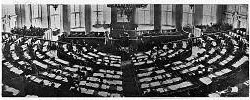 The government of Rovens is provided by the majority party, or coalition of parties,
in the National Assembly, a proportionally elected body of 500 representatives called
Members of the National Assembly (MNAs). The President of the National Assembly
is then elected by the members from the body of the National Assembly, who will act as the
Administrative head of the government, providing leadership. The President will run the
government in the day-to-day sense. The President retains office until the National Assembly
elects a replacement.
The government of Rovens is provided by the majority party, or coalition of parties,
in the National Assembly, a proportionally elected body of 500 representatives called
Members of the National Assembly (MNAs). The President of the National Assembly
is then elected by the members from the body of the National Assembly, who will act as the
Administrative head of the government, providing leadership. The President will run the
government in the day-to-day sense. The President retains office until the National Assembly
elects a replacement.
 President Weissman is the Guidarman leader of the Democratic Reform Alliance,
a coalition of parties of the centre of politics. The party is a party of the moderate
centre of Rovenian politics, pro-capitalism but with a human face. However, the first
edition of President Weissman's government was marked with tight budgetry constraints
and a strong economic reform agenda, that resulted in hundreds of thousands of government
workers losing their jobs.
President Weissman is the Guidarman leader of the Democratic Reform Alliance,
a coalition of parties of the centre of politics. The party is a party of the moderate
centre of Rovenian politics, pro-capitalism but with a human face. However, the first
edition of President Weissman's government was marked with tight budgetry constraints
and a strong economic reform agenda, that resulted in hundreds of thousands of government
workers losing their jobs.
In his second inauguration address, the President pledged to "soften" the tough line
his government had taken in its first term. It would not sway greatly from fiscal
responsibility, but would "slacken the constraints a little". The President told the
National Assembly that he would retain focus on the three designs of his first government:
improving the economy, continue talks with the rebel Pataki communist government,
without "surrendering the nation", and providing improving levels of education, health
care and provide a "modest" military.
 Under the Rovenian system, there is a inner or senior cabinet, plus a junior cabinet that
reports to the senior ministers. The inner cabinet is only small, with Presidents K'yonte
and Kope has five members, while President Weissman expanded his to six and now seven members.
Under the Rovenian system, there is a inner or senior cabinet, plus a junior cabinet that
reports to the senior ministers. The inner cabinet is only small, with Presidents K'yonte
and Kope has five members, while President Weissman expanded his to six and now seven members.
Politically, senior cabinets will include members from each of the main parties.
The Rovenian Cabinet consists of the following members:
- Armande Dupont, leader of the Democratic Union Party, becomes Finance
Minister, responsible for the government's budget, and works closely with the
Economy Minister. The position has been reduced in power compared with the
government's first term.
- Janomi Kontoy is Infrastructure Minister, responsible for roads, highways,
water, gas and electricity supply and all government construction projects and government
companies. Kontoy is the leader of the socialist PIMR coalition party.
- Geoffrey Bos, leader of the National Democratic Alliance, a centrist party
that left the PIMR coalition in May 303ap, is the country's Economy Minister.
He is responsible for economic policy, Industry and manufacturing, and for trying
to restore the national economic health. He will work very closely with the Finance
Minister.
- John Forsythe, a senior member of the socialist PIMR, is Exterior Minister,
responsible for communicating with the international community and maintaining the
Rovenian embassies, appointing ambassadors and managing foreign policy. The former
policeman is also responsible for "getting the message out" and maintaining the
government website.
- Charles Van Hooven is National Security Minister, responsible for
the Military, intelligence and security of the nation. Mr Van Hooven is deputy-leader
of the Democratic Union Party.
- Karl Werten, a senior member of the President's DRA party, is elevated to
the senior cabinet position of Interior Minister, responsible for all
matters of the interior, from justice, security, health, education and social
services.
- Abraham Kopana, the leader to the moderate right-wing Peoples Party of Gvonj,
returns as Agriculture Minister, responsible for reform of agricultural
industry.
Adolph Gottlieb, who served as the President's Finance and Economy minister has been
returned to the backbench of the DRA party. Paul van Looyan, a formerly senior member of the
outer cabinet, is no longer, as his Conservative Party of Rovens did not qualify to be in
the National Assembly.
Government policy is directed by the President, the cabinet, and the Assembly. All laws
must be passed by the Assembly, and all actions undertaken by the cabinet or President will
be reviewed by the Assembly as well. The President has no power over the Assembly, except that
he may dismiss it and call for fresh elections.
Elections are normally to be held every five years or less, with the President having
the sole ability to call an election. If one is called, the Assembly may not overrule the
President in this instance.
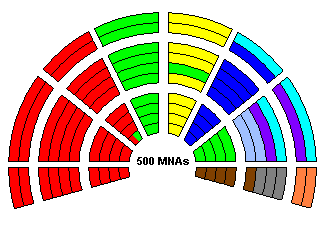
The parties as at the June 21, 303ap, election:
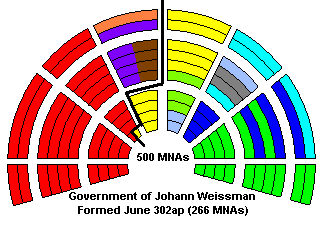
Party in the National Assembly . . . . . % of popular vote, and consequent number of MNA
"Green coalition" Government Parties (46.3%, 266 MNAs)
 Democratic Reform Alliance (DRA) . . . . . 12.8% . . 73 (liberal centrist)
 Peoples Inde' Movement for Rovens (PIMR) . 10.1% . . 58 (socialist; coalition)
 Democratic Union Party (DUP). . . . . . . . 8.1% . . 47 (Conservative)
 Peoples Party of Gvonj (PPG). . . . . . . . 7.1% . . 41 (Centrist, ethnic)
 Cruistian Democratic Alliance Party (CDAP). 3.0% . . 17
National Democratic Alliance (NDA). . . . . 2.7% . . 16 (liberal centrist, former-PIMR)
 Rovenian Burovian Party (RBP) . . . . . . . 2.5% . . 14 (Burovian)
Non-government and Opposition Parties
 Pataki Communist Party (PCP) . . . . . . . 31.9%. . 183
 Liberal Party (Lib) . . . . . . . . . . . . 4.4% . . 25 (far-right, neo-fascist)
 Shi Koneya Gvonjia (SKG). . . . . . . . . . 2.4% . . 14 (Gvonj-Utani nationalist)
 Communist Alliance Party (CAP). . . . . . . 2.2% . . 12 (anti-PCP communists)
12.8% of votes were for parties that failed to win more than 1.5% of the national vote, and thus representation.
Rovens "Green Coalition" government (Feb'302 to June 303):
On February 15th, at 11am in the morning, something happened that had never, ever
happened in in the People's Republic of Rovens: polling booths opened, and the 14.5 of
15.5 million voters of this great nation voted for the future of their country.
 Since the beginning of the nation, January 1st, 301ap, the country was governed by a
collection of delegates to the National Assembly, as chosen by the 174 town and city
councillors of the various shires in the country. Though not democratically elected, they
represented the will of the people, giving direction to the country during the particularly
harrowing formative fourteen months of the Republic.
Since the beginning of the nation, January 1st, 301ap, the country was governed by a
collection of delegates to the National Assembly, as chosen by the 174 town and city
councillors of the various shires in the country. Though not democratically elected, they
represented the will of the people, giving direction to the country during the particularly
harrowing formative fourteen months of the Republic.
After the February 15/16 election, the President, who retains office until voted out,
swore in the coalition government of incoming President Johann Weissman, a ten-party,
258 member coalition known as the Green Coalition. President Weissman assumed
control of the government on March 4th, and appointed his cabinet two days later.
President Weissman is the leader of the Democratic Reform Alliance, a coalition of
parties of the centre of politics. The Party upholds the principles of individual freedom and
freedom of the markets, believes in capitalism as the economic system, but is not committed
to government inaction in the face of either inefficiencies of the system, or imbalances or
unfairnesses. In fact, the DRA is committed to "free but fair capitalism" says the President.
Born to Guidarm parents (orig. Westrian), President Weissman said in his opening speech
to the National Assembly on March 4th, 302ap, that he would "commit myself to the task of
revitalising the national economy, and expanding the wealth that this brings, so that all may
share in it." He also committed the government to talks with the communist rebels that occupy
up to a third of the country, but would refuse to consider autonomy for the communist rebel
government there, only an amnesty for the leaders and members of that government.
President Weissman committed to providing excellent levels of education, health and
social services to accommodate the population. He would also stop the reduction in size of
the military -- a policy enacted by President Kope.
The Rovenian Cabinet between February 302 and June 303, consisted of the following members:
- Adolph Gottlieb is the Finance and Economy Minister, the most powerful of the
senior cabinet positions, as it is responsible for the government budget, the Reserve
Bank and finances, and for all government action with regard to the economy. Gottlieb
is deputy leader of the President's Democratic Reform Alliance party.
- Charles Van Hooven is Exterior Minister, responsible for communicating with the
international community and maintaining the Rovenian embassies, appointing ambassadors
and managing foreign policy. He is also responsible for "getting the message out" and
maintaining the government website. Mr Van Hooven is deputy-leader of the Democratic
Union Party, a conservative member of the "Green coalition" government.
- Janomi Kontoy is the Interior Minister, responsible for all matters of the interior,
from justice, security, health, education and social services. She is a leading member
of the PIMR coalition party.
- John Forsythe is Minister for the Military, intelligence and security of the nation.
A former policeman and the second member of the PIMR coalition party.
- Abraham Kopana is Agriculture Minister, responsible for the primary industry of
the country: agriculture. Kopana is the leader of the Peoples Party of Gvonj, one of the
leading parties in the coalition government.
- Armande Dupont is the Minister for Infrastructure, responsible for roads, highways,
water, gas and electricity supply and all government construction projects and government
companies. He is the leader of the Democratic Union Party.
Paul van Looyan (CPR) and Karl Werten (DRA) are experienced members of the junior or outer
cabinet.
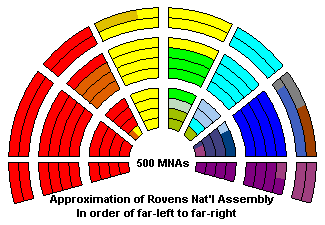
The parties as at the February 15/16, 302ap, election:
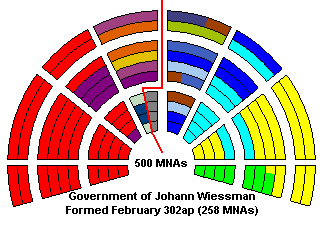
Party in the National Assembly . . . . . % of popular vote, and consequent number of MNA
Pataki Communist Party (PCP) . . . . . . . 32.8%. . 168
Peoples Inde' Movement for Rovens (PIMR)*. 18.0% . . 90 (coalition of many parties)
Peoples Party of Gvonj (PPG)* . . . . . . . 8.8% . . 44 (Centrist, ethnic, PIMR)
Democratic Union Party (DUP)* . . . . . . . 7.8% . . 39 (Conservative)
Liberal Party (Lib) . . . . . . . . . . . . 5.2% . . 26 (far-right, neo-fascist)
Democratic Reform Alliance (DRA)* . . . . . 4.8% . . 24 (centrist, PIMR)
Communist Alliance Party (CAP). . . . . . . 3.8% . . 19 (anti-PCP communists)
 Loyalist Nationalist Party (LNP). . . . . . 3.4% . . 17 (pro-Guwimith Empire)
 Conservative Party of Rovens (CPR)* . . . . 2.6% . . 13
Cruistian Democratic Alliance Party (CDAP)* 2.2% . . 11
Shi Koneya Gvonjia (SKG)* . . . . . . . . . 2.2% . . 11 (Gvonj-Utani nationalist)
 Pataki Reformist Party (PRP)* . . . . . . . 2.2% . . 11 (Pataki anti-communist)
 Socialist Independence Movement (SIM) . . . 1.6%. . . 8 (socialist umbrella)
Rovenian Burovian Party (RBP)*. . . . . . . 1.6%. . . 8
 Independence for the Pataki Party (IPP)*. . 1.4%. . . 7 (anti-PCP)
 Peoples Democratic Reform Party (PDRP). . . 0.8%. . . 4
 Liberal Democratic Party (LDP). . . . . . . 0.8%. . . 4
* Party in the Green Coalition government.
© 302; Rovenian federal government.
<Tech> 
Copyright © 2002 - Mike Ham
(except where copyright held by Edward Mooney, Jr., or their respective authors)
All Rights Reserved. Not to be copied or reproduced in any way without permission.
Webmaster: Mike Ham