
|
Issue 36,
Volume 8, 28 January 302 AP The Story behind the news. |
|
Business
Wage pressure on Economy Savant announces price rise Politics Confederation Day President's 15 billion gifts Could the Chiquiti Crisis ever happen again? Law Challenge to Bayer's new team International Cimera's independence Africablue's succession Sport Football's new eye Winter Vexgames pressure |
|
Subscribe to Zeitgeist
Subscriber queries |
|
What IS a Zeitgeist?
Jerman for "Spirit of the Age". In this case it is to mean the "spirit" of the Utanian people, the magazine reporting the people's thoughts behind the press-releases and reported news. Want an article published? Would you like an article published by Zeitgeist Magazine? Please send the text of the article for evaluation, OR send us an email describing the issue/story you would like published to the email Editor@jaggedblue.com. |
|
©Zeitgeist Magazine, 302 AP.
Email: Editor@jaggedblue.com <TECH> ©Mike Ham, 2002. All rights reserved. No reproduction without, at least, tacit approval. ;-) |
|
Could the Chiquiti Crisis Happen again?
It was a little over a year ago, that a health crisis infected Utania, and brought the government to the point of admitting that it was ill-prepared to cope. What since then has changed, and what changes have the government instituted that might prevent the same in the future? 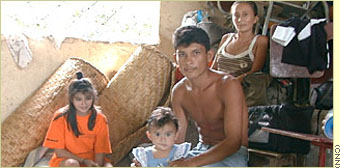 It began with the influx of hundreds of thousands of Utani from South Bay upon the
declaration of independence for Utania. They came with what few belongings they could carry,
and left in their poverty for hundreds of years, that wasn't much. Adding a 160,000 refugees
to an area of 900,000 people (the Chiquiti region) was pressuring the already thinly
stretched health facilities to breaking point, and overruning the water and waste water
systems.
It began with the influx of hundreds of thousands of Utani from South Bay upon the
declaration of independence for Utania. They came with what few belongings they could carry,
and left in their poverty for hundreds of years, that wasn't much. Adding a 160,000 refugees
to an area of 900,000 people (the Chiquiti region) was pressuring the already thinly
stretched health facilities to breaking point, and overruning the water and waste water
systems.
Soon enough, in cramped, appallingly ill-prepared conditions in Chiquiti City and in refugee camps on the border with South Bay, that water borne diseases started appearing in the country that had largely, over the past 70 years of more benign civilian Governors, been eradicated. The much=feared C-word, "Cholera", started spreading amongst the poorest refugees, and then through the city's regular population, and within weeks, Doctors advised the President, the problem would become an epidemic. In the December 18th edition of this magazine, we reported the death of a four year old girl, Amarea Otchekta, and the public, and we suspect the President, became aware of the growing health crisis. Realising that the country's own highly segregated health facilities would not be able to respond in time, Minister for Health Stanton leapt into action, calling on emergency assistance from overseas. Bowdani, Feniz and Ordland all responded, but the Opposition berated the Minister for reducing Utania into a "seemingly hopeless international case". The mostly affluent regions-sourced Opposition MPs felt that this was not the Utania they knew. Problem was, said the President, they only kew one part of Utania. International Response Aid workers from Bowdani, Feniz and Ordland heeded the call and raced to assist Utanian military hospital staff already on the ground in Chiquiti. The President appointed a politically neutral -- neither government, nor opposition -- Utani Progressive Party MP, John Kopeya, to lead the operation.  Kopeya helped the three international teams settle in, and prioritised their tasks,
with Bowdani's Dr John Heince effectively leading the charge in Chiquiti City. Chiquiti
City Hospital received a major make-over and refurbishing, while the city's sewerage
system received a major upgrading.
Kopeya helped the three international teams settle in, and prioritised their tasks,
with Bowdani's Dr John Heince effectively leading the charge in Chiquiti City. Chiquiti
City Hospital received a major make-over and refurbishing, while the city's sewerage
system received a major upgrading.
With the international and local effort, a Cholera crisis was averted, the sick were cured with only a few dozen deaths resulting from what could have been a major catastrophe. Yet, the reliance on international medical aid worried the Parliament, certainly worried the more affluent northern population, and caused the Opposition to demand to know why. The reason was straight forward enough: the country is the fusion of three former provinces under the Guwimithian regime, and so there were three Health departments, and the health department responsible for the Chiquiti, Utani B'yan state, was poorly funded and ill-prepared for the crisis, while medical staff in the northern states, Lasanne and Nystonia, were better prepared for a crisis in their own backyard and hadn't dealt with Cholera in over fifty years, and was less than enthusiastic about helping out. The question that remains to be answered is whether this is still the case, could it happen again, and what measures have the government instituted to prevent such a crisis reappearing elsewhere in the country? Government Action Kopeya, a former Savaj Netopik executive, lost his Parliamentary seat in July, but kept working as Mission-Director for the Chiquiti effort, overseeing the international aid teams leaving their task to local semi-trained and trained medical staff. Since then, Kopeya has been actively campaigning for a national Health Crisis response unit, indeed for a centralised health department, and for a long-term solution for water borne diseases. And he has been recently quite successful. He has been actively lobbying the President for funding for an overhaul to the nation's waste and water infrastructure, and the President announced on New Year's Day, a budget of some fifteen billion Utanian Punds toward ensuring the country has safe drinking water and the means to distribute it. The President put his Û15 billion plan in terms of a "commitment to safe drinking water", and with almost 70% of widespread potentially fatal diseases being from water borne bacterial or parasitic causes, the President's promise will probably provide the most significant improvement in disease control of any action he could take. It will make the poorer cities of western Utania, such as Chiquiti, Kanhara, and Gorana, liveable, without the threat of disease overtaking the cities' urbanising populations. Public Housing would be second on the list, as millions in cities are still living in shanty-towns without adequate public facilities. Yet, the plan includes the building of tens if not hundreds of thousands of public water and public waste facilties. As the President rightly observed in his New Year's Day speech, clean water and human waste disposal are arguably the two greatest hallmarks of civilisation, and allow cities to survive. Waste water treatment is also essential for towns or populations downstream from major cities. John Kopeya is not the first to recognise the need and lobby the President. Dr John Heince, Director of the Bowdani mission to the Chiquiti crisis, put forward a multi-million pund proposal to pipe clean water to the rural refugee camps near the border with South Bay, where some 60,000 people were living in the dry conditions. It was a bold and worthy proposal, but both President Okarvits and Kopeya agreed that the refugees should not be left to live away from civilisation, instead should be provided with housing in Chiquiti City where facilities could be more easily provided. Perhaps something Heince knew that neither the President nor Kopeya knew was that the Chiquiti refugees from South Bay had little desire to live away from the border, away from their traditional homelands over the border. They were happy to live close to the border so that "when things quietened down" they could return more quickly. Unfortunately, the situation in South Bay does not lend itself to such optimism. Health Departments Another major improvement has been the creation of the HuMOC-like Federal Disease Control Centre (FDCC), a Û100 million, 270-employee division of the federal Health Department, responsible for coordinating disease control response, storing vaccines while maintaining strong links into each of the three or four health departments of each state. However disappointingly, the states are still responsible for Health maintenance, and even the FDCC has no power to order mass mobilisation of health facilities or professionals. In other words, should another outbreak occur in south-western Utania, Doctors in Luka cannot be compelled to go help unless their Governor tells them to, and in Luka that would probably represent a breach of contract. State governments continue to fund and manage their own health departments, and Lasanne hospitals, many of them privately owned, resist any change in this policy. They fear a funding crisis, with the more needy Utani B'yan and Savana states draining funds for their specialist elective surgery units or research projects. This is unfortunate, because it is fostering an unhelpful sentiment between the states and their health departments. One hand is not helping the other, yet the President is reluctant to upset the powerful Lasanne health electoral lobby with only a year until he is facing voters. "Fortunately", the tropical diseases, those that require vaccines, such as Yellow fever, are concentrated in the north of the country, where facilities and medical skills are best, and funding is highest. Yet, it also means that the Ujam and Ramali areas of Utania are most likely to be the sites of such outbreaks. Furthermore, these areas are close to the relatively porous border with South Bay. Although, after the rebel incursion into Utania in June last year, the border has been increasingly solidified with the creation of a Border Patrol division, Border patrollers are not instructed to quarantine people, nor how to spot symptoms of fatal diseases. Furthermore, South Bay's own medical and disease prevention controls are largely broken down, and the resultant threat to Utania's northern population is not being checked or monitored. A TRUE government Utania can ill-afford another health crisis like that of thirteen months ago. The loss of confidence in the independent government was severe. Though it is worth noting that the government parties gained an additional 11% of the popular vote in the Chiquiti electorate (from 46% to 57%) between the September 300 and July 301 elections. While it may cause a loss in confidence, the rapid and determined reaction by Minister for Health Stanton, in the face of Parliamentary criticism, seems to have earned the government a great deal of kudos. Then again, perhaps it could be argued that this is due to the rebuilding of the city and creating over 30,000 jobs in the process. It is said that governments and leaders are made or broken by crises; the saying should also say that it is TRUE governments and leaders that prevent them happening in the first place. |
Stock Exchange:
 Stocks continue to stagnate - when will the Govt. release cash controls? |
