
|
Issue 6,
Volume 9, 1 July 301 AP The Story behind the news. |

|
Business
Belson prowls for Blakely Is Uyu selling the Farm? Politics The President's land reform agenda Con-CDP nominee line-up Law Holding back the Guwimithian wolves International Rovens: Keeping Keralski quiet Dignania: Would Kemp withdraw? Sport Football: Utania's new UFA Football: Victory in Zartania! Golf: Where HAS the golf gone? |
|
Subscribe to Zeitgeist
Subscriber queries |
|
What IS a Zeitgeist?
Jerman for "Spirit of the Age". In this case it is to mean the "spirit" of the Utanian people, the magazine reporting the people's thoughts behind the press-releases and reported news. Want an article published? Would you like an article published by Zeitgeist Magazine? Please send the text of the article for evaluation, OR send us an email describing the issue/story you would like published to the email Editor@jaggedblue.com. |
|
©Zeitgeist Magazine, 301 AP.
Email: Editor@jaggedblue.com <TECH> ©Mike Ham, 2001. All rights reserved. No reproduction without, at least, tacit approval. ;-) |
|
Land Reform's endless controversies
Land reform is one of the more contentious and fraught issues that the government and the President have had to face. Yet, this week's new land-ownership law provides a clue as to the direction the Okarvits administration is heading in. Land reform was the rallying cry of Utani MPs when independence was granted over two years ago, but the government has been nothing but slow moving on the topic. That is because President Okarvits does not know what to do, claim opponents and analysts. Not so, claim his supporters, but the President must take a moderate line, because the extremes could devastate the country. Yet, there are signs that Utani voters are getting increasing agitated about the issue, and their federal government MPs in turn. 1.5 million voted for the conservative parties in the last federal election from what one would assume to be strongly Utani nationalist regions of Chiquiti, Kanhara and Tuama, the western tribes, meaning the government's hold is nothing to be taken for granted. Worse yet that any of these parties offer a viable alternative. Problematic solutions To be fair, the issue was never going to be easy. On one extreme, the Utani people could simply rise up and seize the lands owned by white farmers. The consequence would be the end of agricultural production, and the end of the export boom that accompanies it. A legal nightmare of land transfers by occupation would follow, with police being either compelled to forcefully evict the occupiers, ending the government's support base, or the police and government joining in support of the occupation, ending in international sanctions and loss of export markets. In either case, the rule of law would be violated, white farmers would flee the country and economic collapse would most likely follow. The less extreme alternative is that the government buys the land back, but this is enormously contentious and expensive, and, so far, Utani Saedaj government MPs have hampered such plans. Why pay for land that already belongs to the Utani, that was forcefully confiscated? Furthermore, why pay an estimated Û1,100 billion, twice the size of the economy, and more than fifteen times the government's budget, for land already belonging to the Utani? Of course, this also assumes that the "white farmers" are ready and willing to sell. Should the government force them off their own farms, while paying them a standard rate, or should it buy the farms according to the farmers' demands? Furthermore, what becomes of the productivity of the farms, when experienced farmers leave them to Utani communities with, perhaps, little talent for farming, or, more importantly, managing farms. These concerns have been echoed repeatedly by the President's top staffers, indicating the level of caution the Administration is taking. As Zeitgeist Magazine pointed out when the President was elected almost two-years ago, he would need Solomon's wisdom to weave a solution. And, yet, there are clues the President is so gifted. What's good enough for foreigners... This week's land-ownership legislation offers the best path to solving this problem, and a clue to the President's mind on land reform. The new law prevents non-resident foreigners owning land, but does grant them leasing rights that are very secure. The leases are for ten to ninety-nine years, with a minimum ten year warning-of-intent from land-owners to leasers before the latter can be "evicted". Yet, even this will not satisfy farmers. Afterall, billions of punds in loans have been granted to these farm-owners for new store-sheds, new tractors, new technology to enhance the productivity of their farms, on the basis that should they default, at least the bank had their land as security. But, not if they don't own it. A Reserve Bank team established to assess the impact is due to tell the government that the consequences of this would be the default on billions of punds worth of loans. The obvious solution is that the government guarantees the loans, and pays up should the farmers fail to pay. Yet, even this is not enough, because it only secures the loans of today: what about tomorrow, or next year? "No land, no business" "I think it would be fair to say that it would destroy the farming industry in this country", says Henry Papa Caureaczek, head of the Tobacco Farmers Federation, and a tobacco farmer from the Hamilton region in Lasanne state. "We would have nothing against which to sure-up the business. We want a loan, but what would we have to secure the loan against? The business? That's not worth squat if the Utani pull the rug out from under us and take back the land — no land, no business. no business, certainly no more loans, and no more expansion of the business." "I think Utanian farming would be left behind in the 80s for the next forty years." And the Utanian Farmers Federation agrees. In its annual report to members on April 14th, the UFF told members that the "biggest threat to the future of farming is the prospect of land being removed from the equation without compensation for farmers". The UFF claims that if farmers are simply "duped" out of their land, that is, transferred without compensation, then the farming industry would, most likely, collapse under the weight of business development loans. It is a result, the UFF claims, the country can ill-afford. A possible solution? Not so fast, demands the Utani Business and Economic Foundation (UBEF), a non-profit Utani nationalist think-tank based in Utan Krysaror. UBEF says the farmers would have their loan guarantees made by the land-owners, being the local Utani, who would, in turn, profit from the return made on the investment. "This is a very good thing not only for the economy, but for the Utani people", says an excited Dr Jeff Omara of UBEF's agricultural economics unit. "The law could guaranteeing 40% of the value of the land to the farmers, not theirs to own, but theirs to use in developing their farming businesses. 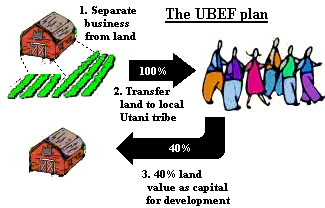
"It would be an compulsory investment by the Utani community in that business that the farmers would have to treat as an equal partner in that business. This empowers the communities, and gives the farmer the development capital he needs." Furthermore, Omara claims, it would be a huge boon for the Utanian economy. "All this suddenly available development funding backed by the land that was previously under-capitalised. Utani communities will become their own business managers for a start, and have a wealth of money to invest for their own development. "It's good all 'round." The UFF disagrees. "Most farmers I know have 80% of their land tied up in loan guarantees, so 40% is barely going to cover half of them", claims Caureaczek. Worse yet, he points out, farmers will be losing the one thing that their ancestors have been passing down to them. "Yes", Omara observes, "We Utani know that feeling very well." |
|
Recent Editions and articles:
The Con-CDP candidates Weissman's chances at holding on to power The new UFA Piers Knossa interview |

Stock Exchange:
 Stocks continue to stagnate - when will the Govt. release cash controls? |
