
|
Issue 25,
Volume 9, 11 November 302 AP The Story behind the news. |

|
Business
Belson's misstep Inflation not as bad as thought Politics Artos's stunning victory and its consequences Utani B'yan by electorate How did he win? President outright winner - Polls Boornal reminds voters Law Could there be nothing worse? Making sense of labour laws International Cimera: Hostilities begin Is there something wrong with assassinations? Rovens: Government threatened from within Sport Football: Second division ends the year predictably |
|
Subscribe to Zeitgeist
Subscriber queries |
|
What IS a Zeitgeist?
Jerman for "Spirit of the Age". In this case it is to mean the "spirit" of the Utanian people, the magazine reporting the people's thoughts behind the press-releases and reported news. Want an article published? Would you like an article published by Zeitgeist Magazine? Please send the text of the article for evaluation, OR send us an email describing the issue/story you would like published to the email Editor@jaggedblue.com. Article authors It is the policy of this magazine not to identify the authors of any Zeitgeist articles. It was conceived in the early days of this magazine, by our founder, Mr van der Hamm, when authors were being threatened by Guwimithian Authorities for their anti-Imperialist columns. Our founder endured jail time in Imperial prisons for his "insolence". Now, the policy is to demonstrate that this is a magazine, not a collection of authors. |
|
© Zeitgeist Magazine, 302 AP.
Email: Editor@jaggedblue.com <TECH> ©Mike Ham, 2002. All rights reserved. No reproduction without, at least, tacit approval. ;-) |
|
Utani B'yan: But... How?! Why?
They won 609,850 fewer votes (6% of the total) than the opposition party bloc, but the Artos government has been returned with 94 seats to the opposition's 65. How can this be? More importantly, given this is the exact same system used federally, what consequences are there for the Presidential and future federal elections? Governor Artos would have woken on Saturday morning filled with dread. His government was a good seven points behind the opposition, and voters were tiring of continuous Peoples-Utani Saedaj governments and wanted change. By the end of the day, Governor Artos has not only secured his job, he'd won an unexpected landslide election over the opposition. Ironically, however, he did so with the polls still being right. And now opposition parties are worried that this could be a permanent feature of federal elections, while pundits and pollsters are rethinking all they thought they knew about the uniquely Utanian electoral system. 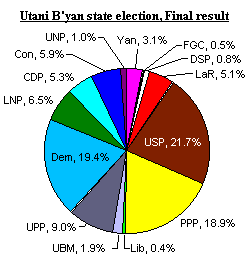 The state government ended the night with a mere 41% of the popular vote,
while the five-party opposition won 46.1%. Yet, the government won a landslide
electoral victory, guaranteeing the next four years in office. However, while
Governor Artos has been returned with a much stronger margin in the state
Parliament, something must be said for the fact that 600,000 more voters
preferred the opposition than the government. Governor Artos is immediately
a less popular leader than his opponent, a fact that may yet haunt him for
years to come. (See accompanying article.)
The state government ended the night with a mere 41% of the popular vote,
while the five-party opposition won 46.1%. Yet, the government won a landslide
electoral victory, guaranteeing the next four years in office. However, while
Governor Artos has been returned with a much stronger margin in the state
Parliament, something must be said for the fact that 600,000 more voters
preferred the opposition than the government. Governor Artos is immediately
a less popular leader than his opponent, a fact that may yet haunt him for
years to come. (See accompanying article.)
So, how did he snatch victory without actually being popular? Perhaps another electoral system would be better? It should, by now, be no secret that the responsible entity, at least as far as much of the media and public, plus some opposition figures, are concerned, is Utania's unique electoral system. However, this is a misconception the Artos government will be forced to fight in order to justify their victory to a grumbling electorate. By mixing proportional representation and first-past-the-post, the Horn of Olives provincial government of Governor Abraham Okarvits hoped to provide smaller parties, as their own had recently been, better access
For example;
to Parliament, but without surrendering the Parliament to them, and creating
the sort of wide, unstable coalitions that currently besets Rovens.
The people of Waverley electorate in Utan Krysaror, voted for the following parties as follows: * Democrats 26.6% * Peoples Party 18.8% * Utani Saedaj 15.9% * Republican 10.6% Now, the first of five seats goes to the Democrats, then to the Peoples Party, and then the Utani Saedaj. Next would have been the Republicans, but since they have less than half the votes of the Democrats, the electorate's fourth seat in Parliament goes to the Democrats. Then, the Republicans get the fifth seat. For a full explanation of the system, refer the Utanian government site. Instead of each electorate sending one MP to Agraam (the state capital), it would send anywhere between two and six, and determine who those MPs would be by a system resembling proportional representation. It would mean that the two major parties (as there was then) would get to elect MPs, but that in the larger electorates, MPs from smaller, less popular parties, with perhaps strong regional support, could also get elected. Few parties should complain about the system, because all benefit from it. Most parties owe their presense in the current state Parliament to this system, from the Republicans to the Conservatives, and the opposition has arguably gained the most. In fact, the Utanian system of MMCP worked in favour of the opposition coalition. Had Utani B'yan state been operating
In fact, not only would the government still have been elected under FPP,
it would have been returned with an even larger margin.
with FPP (First-Past-the-Post), there would only be four parties in the
Parliament, Utani Saedaj, Peoples, Democrats and Liberal Nationalists.
Furthermore, Zeitgeist Magazine has calculated, by attributing all MPs for an electorate to the leading party -- so that Waverley electorate would send five Democratic MPs to Agraam -- that the current Parliament would, under FPP, have 70 Utani Saedaj MPs, 36 Peoples, 54 Democrats and 5 Liberal Nationalists. Not only would the government still have been elected, it would have been with an even larger margin: 106 MPs to 59. The only way the opposition would get the representation its strong popular support demands would be by proportional representation. However, the opposition would only have 46% of the seats, and no other right-wing parties would have been large enough to tip them over the 50% requirement. The opposition knows it, and are unlikely to ever push for such a system. What killed the opposition's hopes for victory was not the electoral system, but the fact that there is not a united front on the political right. United we stand... Dr Knowle's Democrats are the only party of the opposition that comes close to the size of the two government parties, while the other opposition parties tag along on its coat-tails with between 9 and 5.3% of the state vote. In effect, the four parties share in the other 26.7% of the vote, making them invariably fourth or fifth place parties in most electorates, and in many electorates unable to even snatch a single seat from the three main parties.
Had the four parties united as one party on the ballot, Dr Knowles would be governor today.
What would have made a substantial difference to the election result would
be if the four minor opposition parties, Utani Progressive, Liberal Nationalist,
Cruisian Democrat and Conservative, had joined forces to become one single party.
Zeitgeist calculates that "Party IV" would have won 51 seats rather than the 23
the four parties won alone. The Democrats would have lost seven seats, the Utani
Saedaj nine, the Peoples Party would have lost eight and the Republicans three.
However, the nett result would be that Utani B'yan would have Governor Knowles
today, rather than Governor Artos.
Just like FPP, Utania's electoral system treats disunity severely. A party split cannot expect to perform as well as a party united. The 19.4% Democrats have 42 seats, while the Progressives, a party half their size in votes, has only 8 MPs. And this lesson should be taken to heart by the federal Democrats who are in the middle of splitting themselves again. The message should be unity, not disunity. Only united can the opposition parties hope to defeat the government.
For example;
So, what impact should this have on the Presidential election? As the
Presidential election does not rely on coalitions, and has a run-off between the
two finalists, the Utanian electoral system has not consequences for
the Presidential election. However, for the federal Parliament, in particular
the federal opposition the consequences of this election are significant.
There is a lesson to be learned, and they have at least a year before another
election to learn it. The Democrats, Liberal Nationalists, Utani Progressives,
Cruisian Democrats, and the Conservatives on a united ticket in July 301 would
undoubtedly have produced a right-wing victory, and elected a "President Hope"
for the past two and a half years.
In the three-MP electorate of Koltij, the votes came out as: * Utani Saedaj 24.7% * Democrats 24.4% * Peoples 12.0% The Utani win the first seat, followed by the Democrats. While the Peoples are in third place, they have less than half the votes of both the Utani and Democrats, so these parties must win a second seat before the Peoples Party gets its first. Since the allocation of seats follows the order of the votes the parties won, the Utani Saedaj win a second seat and the three are allocated. HOWEVER, if the four parties were to combine, they would have a collective 27.6% of the vote, and would get the first electoral seat, Utani Saedaj second and Democrats third. The Utani Saedaj would be denied their second seat, thius the government would have lost a seat to the opposition. This is repeated in electorate after electorate where the government parties lead the voting. The nett result of the four parties merging would be a strong victory to Dr Knowles. However, forging such a coalition should prove troublesome at the least. For one, the five parties have significant differences in policy. For one, the Liberal Nationalists and Progressives don't consider themselves to be the opposition, with the latter even backing the government on certain issues. Furthermore, the nationalists are protectionists favouring a dirigiste approach to government, while the Conservatives and Progressives are free-marketeers who believe business should be left alone by government, with the moderate Democrats and Cruisian Democrats somewhat agreeing. Yet, on the issues of moral order, the Cruisian Democrats are significantly at odds with the Progressives and Democrats. Democracy's test So, would such unity mean the end of "interesting politics" on the right wing? An end to open political debate, instead leaving it behind closed doors of the united party? Perhaps not. Just because parties agree to be united on the ballot, does not mean they need to retain a united presense in the Parliament. There is nothing in Utania's constitution forbidding MPs to realign themselves once the election is over, back to their original parties. If the parties agreed they would have a certain proportion of MPs from each, there is nothing preventing MPs from resigning and designating their successor from another political party, as the constitution permits. Still, it is a fair argument that voters would only really have one choice between the united left and the united right (as the Peoples and Utani Saedaj would no doubt also unify if the right does), rather than the larger number of voting possibilities they have today. In theory at least, voters would then form their own parties to attract the minority voters who prefer not to choose simply between "left" and "right". But, the fact would remain that these parties would be unlikely to have much of a presense in the Parliament, and thus, even less of a voice. Thus leaving voters with fewer choices. The only way to prevent this happening is to turn the electoral system over to proportional representation, but then the consequences might to end up with Rovens-style governments of a dozen parties, and a more distinct lack of leadership. Democracy is about compromise, and for all its faults, Utania's MMCP electoral system presents the best, and worst, of both worlds. Of course, all of this assumes that the political Right in Utania is interested in winning elections. As the federal Democrats proved when they began to break apart and drag the state leader Dr Knowles down into their spat, arguably ending his chances at victory, sometimes the opposition's priorities are otherwise ordered. So much the better for the government. | |||||||||||||||||||||||||||||||||||||||||||||||||||||||||||||||||||||||||||||
Stock Exchange:
 The only hope for capital markets in Utania: Hope! |
