
|
Issue 25,
Volume 9, 11 November 302 AP The Story behind the news. |

|
Business
Belson's misstep Inflation not as bad as thought Politics Artos's stunning victory and its consequences How did he win? Utani B'yan by electorate President outright winner - Polls Boornal reminds voters Law Could there be nothing worse? Making sense of labour laws International Cimera: Hostilities begin Is there something wrong with assassinations? Rovens: Government threatened from within Sport Football: Second division ends the year predictably |
|
Subscribe to Zeitgeist
Subscriber queries |
|
What IS a Zeitgeist?
Jerman for "Spirit of the Age". In this case it is to mean the "spirit" of the Utanian people, the magazine reporting the people's thoughts behind the press-releases and reported news. Want an article published? Would you like an article published by Zeitgeist Magazine? Please send the text of the article for evaluation, OR send us an email describing the issue/story you would like published to the email Editor@jaggedblue.com. Article authors It is the policy of this magazine not to identify the authors of any Zeitgeist articles. It was conceived in the early days of this magazine, by our founder, Mr van der Hamm, when authors were being threatened by Guwimithian Authorities for their anti-Imperialist columns. Our founder endured jail time in Imperial prisons for his "insolence". Now, the policy is to demonstrate that this is a magazine, not a collection of authors. |
|
© Zeitgeist Magazine, 302 AP.
Email: Editor@jaggedblue.com <TECH> ©Mike Ham, 2002. All rights reserved. No reproduction without, at least, tacit approval. ;-) |
|
STUNNING!!
Governor Artos has carried his staggering government, beset with endemic corruption, from the political dust-bin to a stunning landslide victory! But, now he must govern as an automatically unpopular leader. The spectacular victory by the beleaguered Artos government has stunned the country, leaving journalists to analysts, not to mention voters, all questioning how this was possible. At latest count, Utani B'yan has not only returned Governor Artos's government to power, but done so with a significantly improved margin over the opposition. 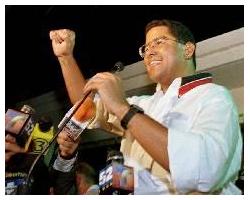 The government now has 94 seats in the Parliament, while the opposition parties
have just 65 (The remaining six seats went to the Burovian's single MP, and the
Republican Party, which is nominally pro-government.) Yet, in terms of actual
votes, the Peoples and Utani Saedaj parties won only 40.6% of the just-under
12 million votes, while the Democrat-lead, five-party opposition won 46.1% of
the vote.
The government now has 94 seats in the Parliament, while the opposition parties
have just 65 (The remaining six seats went to the Burovian's single MP, and the
Republican Party, which is nominally pro-government.) Yet, in terms of actual
votes, the Peoples and Utani Saedaj parties won only 40.6% of the just-under
12 million votes, while the Democrat-lead, five-party opposition won 46.1% of
the vote.
These percentages are consistant with the polls immediately before the election, but demonstrates the very strong bias the Utani B'yan (and Utanian federal) electoral system has toward coalitions of fewer parties. (See accompanying article.)
For seats by electorate, click here for graphic.
Victor in seats only Utani B'yan state is an increasingly urban state, with three cities -- the national capital, Utan Krysaror, the state capital, Agraam, and the industrial centre, Shecker -- making up almost half the state's population of 21 million, including some 5.75 million voters. And, it is in those cities that the opposition were strongest.
In Utan Krysaror, voters gave the opposition parties almost 50% more votes than the government parties, 52% of the total. In Agraam and Shecker as well, the government lagged the opposition, though with much smaller margins. Overall, between these three cities, the opposition received 2.66 million votes to the government's 1.98 million. 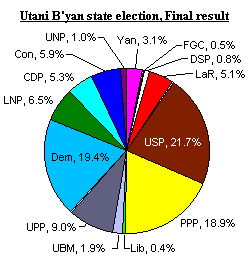 However, sharing that vote between five parties has undermined the opposition
severely. They received only 32 seats in the Parliament, whereas the government
won 38. Furthermore, the government won slightly more votes in the rest of the
state -- 2.95 over 2.87 million -- but this translated to substantially more seats
than the opposition parties: 56 over 33.
However, sharing that vote between five parties has undermined the opposition
severely. They received only 32 seats in the Parliament, whereas the government
won 38. Furthermore, the government won slightly more votes in the rest of the
state -- 2.95 over 2.87 million -- but this translated to substantially more seats
than the opposition parties: 56 over 33.
This demonstrates not only the substantial variance between votes won and seats, it also clearly shows that while Governor Artos won in terms of seats, his is an automatically unpopular government in the cities, particularly the national capital, and marginal in the rest of the state. And this fact should prove the next four years particularly difficult if not well-managed. Traps for young players This means the challenge for Governor Artos will not only be to deliver what he promised, but to deliver an agenda that is accepted by the majority. Unpopular governments that push unpopular agendas have a bad habit, worldwide experience shows, of being subjected to protests, street violence, even revolutions. This is not only important to save his own government, but to placate the electorate before a Presidential election, because his is the most influential state in that election, and could quickly and decisively sabotage President Okarvits' re-election hopes. For example, the proposed Utani Development Bank, a key strategy in the Artos plan, also happens to be somewhat marginally popular. Poor rural Utani
Voters may decide that as they failed to stop the Governor's controversial
plans by voting for Dr Knowles, maybe voting Governor Hope for President
may be the solution.
are all in favour of the free development funding, but tax-payers in the
cities are not so happy. Furthermore, one presidential candidate stood beside
opposition leader, Dr Knowles, and called the development bank "irresponsible".
So, while the bank will not have the chance, over the next three months, to
become the "white elephant" Dr Knowles promises, the perception alone may be
enough. A presidential candidate standing beside the opposition leader the
majority wanted as Governor, but were deprived, is an image campaign managers
can only dream of. Furthermore, if the bank goes ahead unchallenged or
unchanged, voters might decide that as they failed to stop it going ahead by
voting for Dr Knowles, maybe voting for Governor Hope for President may be the
solution.
Certainly Governor Hope will be campaigning along those lines, now. Another trap for Governor Artos will be the proposal to split his state in four, a suggestion floated by those very same rural, traditionalist voters
Governor Artos will need to defuse this issue carefully, and the obvious starting point will be to look closely at why the Tribes want to split the state. They argue that if states, as they are, are merely administrative divisions now that the Utani people are united under a federal government, then why not divide by Tribe? They have tired of being ruled as one collective, tired of the (perceived) corrupt provincial government they endured in the past, and think that, since they now control their own governance (as opposed to the Guwimithians knowing what was best for them), they should have the Tribes rule themselves, just as they did before the plague. Just like much else in Utania, the days of yore continue to make their presence felt in the present. To be sure, there is no particular reason why it could not be the case. There would be an initial cost involved, but, if it keeps the tribal leaders happy, it is quite plausible. What drives Governor Artos is, understandably, self interest, plus a measured dose of Utani prestige. Utania B'yan is the country's largest state, making its usually-Utani Governor the most important amongst his peers. If it is split, that leadership position is left to the Governor of the next-largest state: the Uta-Decashi run Lasanne state. The trick for Gov. Artos will be to present the "No" case for a split emphasising the latter reason, not the former. Or perhaps abandoning his opposition. If not, he may fell a President. There is much riding on the incoming Government's popularity, and no denying that the victor will have to tread very carefully until at least after the Presidential election. There is also no doubt the state opposition will be making that difficult for him, for Governor Artos has an ambitious plan for reforming the state, and ambitious plans have great potential for proving unpopular in some section of the electorate or another, something the opposition and Presidential-aspirants will be hoping for. For Governor Artos, the challenge will not only be to keep his own government popular to prevent civil disobedience, but so as to keep a friendly face in Utan Krysaror. The consequences of a victory in this battle could yet ultimately be loss of the war.
| |||||||||||||||||||||||||||||||||||||||||||||||||||||||||
 A victim of Gov. Artos's success?
Stock Exchange:
 The only hope for capital markets in Utania: Hope! |
