
|
Issue 31,
Volume 9, 23 December 302 AP The Story behind the news. |

|
Cover
Zeitgeist of the year: Pedro Carmonte Runners up: Roven's President and Finance Minister Other key events this year Business Starlight's mistake Kyle Langley: pro-unions? Politics Gov. Hope tours the south "Pardon? There's a drought?" Are the Burovians a spent force? Law The bitter fight over Savante's millions International Gichadia: island paradise comes of age The Moun's Front legacy Pataki Communists refuse "dregs" Castronovia: recog- nition or bust Entertainment Samsarini games ICARA's Alphalpha 300 debacle |
|
Subscribe to Zeitgeist
Subscriber queries |
|
What IS a Zeitgeist?
Jerman for "Spirit of the Age". In this case it is to mean the "spirit" of the Utanian people, the magazine reporting the people's thoughts behind the press-releases and reported news. Want an article published? Would you like an article published by Zeitgeist Magazine? Please send the text of the article for evaluation, OR send us an email describing the issue/story you would like published to the email Editor@jaggedblue.com. Article authors It is the policy of this magazine not to identify the authors of any Zeitgeist articles. It was conceived in the early days of this magazine, by our founder, Mr van der Hamm, when authors were being threatened by Guwimithian Authorities for their anti-Imperialist columns. Our founder endured jail time in Imperial prisons for his "insolence". Now, the policy is to demonstrate that this is a magazine, not a collection of authors. |
|
© Zeitgeist Magazine, 302 AP.
Email: Editor@jaggedblue.com <TECH> ©Mike Ham, 2002. All rights reserved. No reproduction without, at least, tacit approval. ;-) |
|
The Carmonte Affair, continued...
It is perhaps easier for Provost Herantro to be flippant about this case when he believe he is immune from prosecution for the actions of his staff. No penalties exist for university management whose staff are sent to prison. Or should we say "penalties known-to-Provost Herantro". Perhaps poetic justice in this case would be that Herantro's ignorance also manages to condemn him for failing to appropriately warn Carmonte. Perhaps there is such hope. Senator da Tenio says that while there is no such obligation to forewarn staff of the law, "there is indeed a requirement that they act to warn staff should they believe a breach of law is imminent." The Provost is adamant that ignorance is no excuse, not even for Carmonte. The law does not need to be well-advertised to be well-known. This is true, as the majority of the Lendosan population has heard of this law. But, a far better question is whether they understand how far-reaching it is. "You can't deny that a university should warn staff that something which could very easily arise in their classes might be illegal" says Guildmaster Calindor. "This is something that could easily be encountered, and yet is not obvious to everyone, even if they generally have a good grasp of the law." The Provost dismisses this: "Why would a teacher of religion be not aware of this, perhaps the most important law pertaining to religion?" What next? Pedro Carmonte's case is currently with a new Judge, undergoing a review, as ordered by the Tribunes. An acquittal is highly unlikely. A reduced sentence the best result Carmonte can hope for. Popular opinion is against him (in a poll, 77% say he is guilty, though only 52% say he received a just sentence), and his own church, for which religion is imprisoned, is unable to help him.
Nonetheless, Carmonte admits to surprise at the level of personal support he has received, squeezed between the bars of his cell. "The Lendosan justice system tends to keep one isolated from all that - officially to protect criminals from mob justice, I'm told." A judgement in his retrial is expected any day, but it will not be the result Carmonte nor his supporters, domestic and international, want to hear. "I think Carmonte should be set free," says Colchisian retiree Pedro Velturo. "Maybe give him a fine or something and order him not to try it again." His waitress, Diana Ulandra, agrees. "Carmonte ought to be set free straight away." Certainly there is ample scope for the Justice Section's investigation. For example, why is imprisonment the punishment of first resort? Why aren't fines or University administrative advices tried first? Carmonte certainly did intend to take the course of action he took in his lectures, but is there any doubt he would have reconsidered had police or the University issued a stern warning of the consequences? Even Senator da Tenio makes reference to the fact that there is a "requirement (on university management) that they act to warn staff should they believe a breach of law is imminent." No such warning, according to Carmonte, was provided. One moment he loses a student in his class, the next he is being arrested. Why didn't police turn the complaint over to university authorities, or did they, and Provost Herantro failed in his managerial duty? Furthermore, there remains the unanswered question of the need to inform staff of their obligations under the law. Asala University's Provost denies it is his, indeed anyone's responsibility to ensure Carmonte knew the law, other than Carmonte's. Making available a several thousand page encyclopedia of Lendosan law to university staff, expecting them to appreciate the subtle nuances of law, is too much. What is clear is that the University has failed Carmonte, but like all bureaucracies, the plight of one small man is immaterial. Furthermore, as there is no law that Provost Herantro has broken in failing in his duty of care, there can be no justice here. Guildmaster Calindor says that in order for teaching staff to not be victims of bureaucratic failures, the government needs to return administrative power of universities to their staff. "We do not expect to see any significant changes in how universities look after their teachers unless the government acts to restore power to the actual educators", he says. However, "The current government has ignored our requests for change." Simply, the law is not working as planned, and it is up to the Senate to make the necessary corrections. All hope seems to rest on the shoulders of the Justice Section's internal investigation, despite its absence of independence. Senator da Tenio must guide the department to develop a convincing case for the Senate to consider a re-evaluation of the "Insecularity Law". And there is every indication that da Tenio is the man for the job. Despite membership of the party that helped forge the Insecularity Law and the dreaded Papaist Church-muzzling Antario Accords, da Tenio is the leading light of the party's reformist faction. His cool exterior belies a sharp mind and an apparent determination to sift out the truth. Furthermore, there are signs that he may be taking a personal interest in the case: da Tenio was recently reported to be at the University of Asala on "unspecified business". If Senator da Tenio can convince the Senate that something is amiss in Carmonte's case, then for Pedro Carmonte there is still hope. Should the Senator prove unworthy of the task, then the only hope left will be for the Tribunes to initiate their own investigation, and subsequently so advise the Senate. However, a criticism not emanating from one of their own is unlikely to be appreciated with quite the same level of concentration. Lendosa's challenge However, there remains one further, more difficult change that required to return Lendosa to a more balanced approach in applying the law. It can be found as a warning in the tale of the Six Virtues.
The Lendosan Confederation shows definite signs of demonstrating the Virtues without moderation: a secretive State, an intrusive and suspicious domestic Intelligence, a bureaucracy resistant to change, and a ruthless and bureaucratic legal system that applies the law without consideration for human failings. It was the bureaucracy that failed to forewarn Pedro Carmonte of his crime. The Bureaucracy that arrested and tried him without providing a warning first. A bureaucracy that sentenced him to ten years prison without questioning whether Carmonte's sentence was the "desired aim" of the law. The bureaucracy simply went about applying the law to the letter of the law. No one deviated, no one questioned. Bureaucracies are the heads, not the hearts, of a government. They do not question, think or consider the implications for individuals, but consider only the total result, over the entire population. It is Merecedato grown wild. For there are few nations in which one can be sentenced like a murderer for a legal "misunderstanding". Fewer still where the infraction is an arguably minor abuse of power. Most civilised nations will impose fines, perhaps even dismiss the case if the accused has not been sufficiently forewarned. At the very least, warnings are issued before prison sentences. It is true, though, that the Lendosan Confederation is not like "most civilised nations". Civilised, yes, but not a liberal democracy in the Christianan tradition. It has evolved from an empire, from an ancient tradition, and from a post-plague history that, like most nations of Vexillium, was brutal, tyrannic, and paranoid. However, this can be no excuse. If it is to survive beyond the Fourth Century, the Lendosan Confederation must find a path of reform. It must relearn the very lesson of the Virtues, and wind back the Bureaucracy. It must learn to trust its people again, learn to be vigilant without paranoia, to provide justice with a heart. For the people are suffering, being imprisoned, and lives are being turned upside down, because of misunderstandings of the law. Unfortunately, this is the most difficult problem to overcome, for the Virtues are so integral to the Lendosan culture and work. However, it must be overcome, for there are possibly thousands of individuals, like Pedro Carmonte, that are suffering under the weight of the Virtues-as-absolutes. It is both time for reform of the law, reprieve for its victims, and a rebalancing of Lendosan society's application of the Virtues, particularly Merecedato, to ensure justice is achieved, not merely the law. While the case of Pedro Carmonte is certainly a domestic issue, the continued security of Lendosan society demands that the international community continues to persuade the Lendosan people and their leaders that these changes are necessary for their own sake. This news magazine, indeed all the world, will be looking very carefully at the results of the Justice Section investigation, Carmonte's retrial and the response from the Lendosan Senate to this case. However, since the wheels of bureaucracy turn slowly, Pedro Carmonte may yet have to accept his fate as a very small man facing down a very large machine. |


 Printer-friendly version of this story.
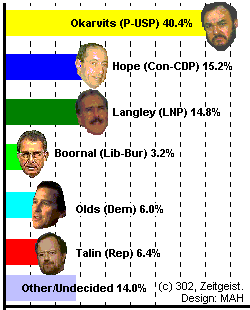
Stock Exchange:
 The only hope for capital markets in Utania: Hope! |
