
|
Issue 16,
Volume 7, 11 September 300 AP The Story behind the news. |

|
Economics
Electricity reform, the new model Election 300 The Seven in the Middle A Peoples Party government anyone? Boornal joins the Burovians! Politics Savana's new elite International Zartanian communists run out of Thistland Sport Golf: Aretesuna slips to world's #46 Football: Tigers roar! |
|
Subscribe to Zeitgeist
Subscriber queries |
|
What IS a Zeitgeist?
Jerman for "Spirit of the Age". In this case it is to mean the "spirit" of the Utanian people, the magazine reporting the people's thoughts behind the press-releases and reported news. |
|
"The Seven in the middle"
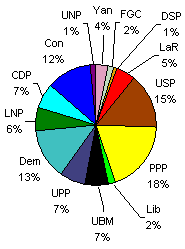
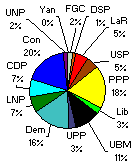
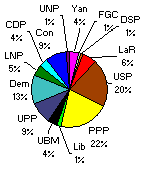
The election may be so close at the end of this month, that it will be up to the smallest seven parties to determine who holds power in October, according to the latest Kapur-Zeitgeist poll.
* July 1 poll conducted by Luka Herald newspaper based on 137 MP's and excluding many minor parties. This leaves the country in the middle. Neither coalition could form a strong enough government to govern effectively, based on the latest poll. The final election may, in fact, be worse, pushing the USP-PPP further from a majority, leaving the country in the hands of a six party right-wing coalition. "It is clear that the seven smaller parties hold the key to power", says Luka University's Professor David Kapur. "The four main parties, Conservative, Democrat, Peoples and Utani-Sædaj, who between them would hold 111 of the 140 seats, that's 79%, will not govern alone, and must select a number of the seven smaller parties in order to hold power." The seven parties range from ten seats to one, and would have held, if the poll was an election, a collective 29 seats. "These seven smaller parties could hold a government to ransom, demanding their way in order to pass other government bills", says political analyst Paul Loiyan. "It could introduce an unfortunate period in our history: democracy held to ransom." It is a charge some of the seven smaller parties deny. The Cruis-Democrats are already a close ally of the Conservatives, just as Robert Talin's Republicans are of the Peoples party. The Liberal Nationalists have also been close allies of the Conservatives, but are currently playing the hard-won lovers, demanding that they be fought for before surrendering their allegiance. (For a mere two seats, they may find themselves waiting quite awhile.) Billionaire James Angorit's Progressive Party would be willing to join a coalition government, and remain loyal to it, in exchange for certain concessions. So too would the Liberals, although their hold on their one possible seat in parliament has left them out of discussions for now. The third "one-term but loyal coalition partners" party is the Burovians, who emphasise that their strong commitment to party integrity will make them very loyal coalition partners, but hard negotiators. The only recalcitrant party is the Yannists. The Yannists have already declared their refusal to join any coalition. "No possible government appears serious about stopping the damage on our people by this rampant capitalism. We will help none of them enslave the Utani." Triumvirate required Professor Kapur, the co-author of the poll, and Luka University Politics Professor, says the only way to escape democracy being held to ransom, is for one of the four core parties (Con, Dem, PPP and USP) to join another stronger two to form government. In this case, he says, the obvious choice is the Democrats joining the USP-PPP coalition. "The USP-PPP bond is too strong to break for one of those two parties to join the Conservative-Democrat coalition." says Professor Kapur. "Beside which, the USP-PPP pair will win 67 seats compared to the Con-Dem's 44 seats (according to the latest poll), making them a stronger government if the 22-seat Democrats joined them, than if the 37-seat PPP joined the 44-seat Con-Dem pairing." "Clearly, the Democrats, for the sake of Utanian Democracy, need to seriously consider this."
|
|
Readers should be aware that the link between the polls and the actual number of seats won
is calculated based on an excel spreadsheet. The poll results for each of the parties for
each electorate, based on one polled voter per 10,000 voters, are entered into the spreadsheet
and added up for each state then nationally, providing the pie graph of percentage support
for each party. This spreadsheet can be made available to other political bodies after this
election simply by sending an email to the author: david.kapur@zeitgeist.com.ut
Each electorate's MP seat winners is calculated using the method laid out at the UEC site. In short, calculating winners is based on largest number of votes: In three MP Virana, the USP won 38%, the Peoples won 22%, Progressives won 20% and the Democrats 4%. Provided the top winner doesn't have double the support of the third place-party, the top three parties get to send one MP each. If the USP had won 41%, or the Progressives only won 18%, then, because the USP has double the support of the Progressives, it gets to send a second MP to Parliament, before the Progressives get to send any. This then demonstrates how marginal the winning of seats can be. |
Stock Exchange:
 Stocks continue to stagnate - when will the Govt. release cash controls? |

|
©Zeitgeist Magazine, 300 AP.
<TECH> ©Mike Ham, 2000. All rights reserved. No reproduction without, at least, tacit approval. ;-) |