






|
|
|
|
|
|
|
|
|
 Read the policies of the Utanian parties, then click the button to place YOUR vote!!
|
| The Democratic Party is the oldest party in Utania, although that is unfair, for the
party and movement that it came from has undergone a split and revised its mission since the
230's when it began.
The democratic movement began in the 190's with reaction against tightening controls by Guwimith over the Guwimith Dependencies. By the 230's it was a call for democracy, the right to vote for regional governments in the Dependencies. By the 250's, the Democracy movement gained its greatest momentum, culminating in the Guwimith Dependencies Act, 266ap, which saw the establishment of the provincial parliaments and cementing the province borders. The Parliaments had limited power, but for most in the democracy movement, it was enough. The satisfied formed the Guwimith National Party, in deference to the Tsar, while a small band of rebels formed the Democratic Party. The Democracy movement rekindled in the late 70's and 80's, and the Democratic Party began to win power in Provincial Parliaments, and called for greater autonomy. The CLM also began around this time, but the Democrats wanted liberation under, perhaps, a Commonwealth of Guwimith. As the momentum increased, and more radical and violent movements began to take shape, but the Democrats stayed true to political pressure. In the 90's, the Guwimith National Party was out of office in the Dependencies. See also History of Utania The Democrats have now achieved their goal, but continue to provide a "plausible alternative to the right wing politics of the Conservative Party, but without going to the Left (the PPP)". The Democrats are the moderate right wing party, neither radical free-market cheerleaders, nor proponents of left-wing policies, the Democrats support liberalisation of the market, but also agree that there must be moderation. They agree with the principles of support for unemployed, but also believe that there must be an incentive to work. The moderate conservative choice lead by Louis Campden. Other notable members include:
|
| The Conservative Party is the new name for the Conservative Liberationist
Movement which formed in the Guwimith Wide Shore (now Lasanne) during the 60's while
Utania was under the Guwimith Empire. The CLM called for liberalisation of business and trade
laws that restricted the dependencies from making the most of their economic potential. It
was, predictably, started by businessmen in the prosperous city of Luka who did not want
actual liberation from Guwimith, too radical a suggestion for those times.
The Conservative Party today is also funded and peopled mostly by businessmen and others with an interest in liberalising the restraints on free market capitalism. Small government which does not support nor hinder the activities of the marketplace is the objective of the Conservative Party, with most services (health, unemployment benefits, education, etc...) provided by the freed marketplace. Lead by President Edward Hope, with other notables:
|
| In 293ap, a split within the Peoples Party developed, caused by years of dispute
between the hardline Cruisians and so-called "Compassionate" or "wet" Cruisians about how
best to approach the issue of morality in the law of the land. The hardliners had long
pushed for certain immoral acts to be banned by provincial law, such as
homosexuality, whereas the "wets" wanted the government to stay out of dictating morality to
the otherwise strongly moral Utani people. The split resulted in the formation of the
Cruis-Democrats, a moderate conservative party on economic policy, but a very conservative
party on issues of "personal morality".
The Cruis-Democrats continued to gain moderate levels of support from voters in the Utani provinces, particularly in Duck Egg Shore (now Nystonia), where they won power in 296 in coalition with the CLM. While their moralist policies have been somewhat muted, several hardline laws have been passed on issues of crime and punishment, including the use of the Death Penalty, normally a right reserved for the Guwimith Imperial Government, in addition to "moral" laws on general public behaviour, sexual relations, and tighter censorship. The party has now moderated its policies on the federal level, promoting its role as the conservative alternative party of Cruisian values. It supports many PPP policies, but is more closely aligned with the Democrats. Lead by Edward Cryer, former Governor of Nystonia, and a moralist moderate, though famous for the quote "No Cruis-fearin' man need fear morality being enshrined in our laws, only deviants do.". Other notables include:
|
|
| In 288, the Utani Nationalist League formed as a popular movement out of the Guwimith
National Party (the loyalists). At first the Nationalists were lapdogs of the Imperialists,
they supported the notion of a great empire of Utani and Guwimithian peoples. With the
collapse of the Guwimith regime, the Nationalists have become two parties: the Imperialist
faction are supporters of an Utanian Empire, relying on racist creeds of Utani genetic
superiority, and modelling themselves after the Zartanian Empire, they would see Utania
create an Empire greater than the Savaj alone created; and a second and larger faction of
fascists, who would purge the Uta-Decashi from the country, expand the borders somewhat and
create a militarist state in which every boy would learn the Utani ideals and lead forth a
nation of genetically superior beings to be the model for the world. They regard pure Utani
blood diluted by marriages to Uta-Decashi as too reprehensible for words, and would ban
such unions. |
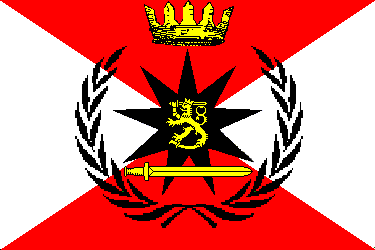
The flag of the UNP is clearly influenced by the Zartanian Empire, but has the nine-point star (one for each Utani tribe), the sword in defence of the empire and the fighting lion of the Imperial seal. |
|
|
Though they claim fanatical support, their numbers are few, particularly since the
devastating Liberal Nationalist split in '94, whom the Nationalists still refer to as
"brothers whose minds have been polluted by the liberal ideas of the internationalist
conspiracy of the UNV". They believe the UNV mission is the enemies of Greater
Utania polluting the minds of the masses, keeping them from their true destiny, and
Nationalists have been responsible for attacks on the UNV before.
An extremist right-wing-dirigiste party lead by former spy Thomas Abels. | ||
| In the early 90's, the extremist rantings of the Nationalists attracted thousands to
their ranks calling for protectionist policies, for protection of the Utani spirit and
gene-pool from the Guwimithian rulers. However, the true nature of the radical preachings of
the Nationalists soon became known, and many began to fall away in disillusionment. So,
several of the new leaders, after a year of discussion on the topic, and lead by a young and
idealistic farmer-turned-lawyer from Duck Egg Shore province (now Nystonia) named Kyle
Langley, split from the party and formed the Liberal Nationalist Party in 294. It was
a massive success, taking over two-thirds of the Nationalist supporters, and attracting
thousands more from the other conservative parties, entrenching it as D.E.S. province's
lead conservative party!
The LNP retained and retain many of the less-extreme policies of the Nationalists: they oppose further immigration of Uta-Decashi and would offer special government assistance to Utani to marry other Utani, the purer the blood the better the funding; they too are strong protectionists, advocating government support for industries so that the nation can stand independent, not relying on overseas-produced goods, and even isolated from the outside world; they too are rabid anti-communists, and would have such parties banned, and such countries relegated to last on the diplomatic relations list; and they support conscription and support the building of a far stronger military "for zealous defense of Utani ideals". And though they have no love of the UNV, the LNP have condemned violence against UNV officers. They are the moderate wing of the Nationalist leanings, and a moderate dirigiste party lead by Kyle Langley, with other party notables:
|
|
| When limited democracy was becoming at last a reality, a young Democrat movement leader
and Democrat MP in Horn of Olives province, 266-268, Abraham Okarvits, became concerned at
the lack of Cruisian values in the newly formed parliament, values that had underpinned the
Utani culture for centuries. In his most famous speech, March 29th, 268, Okarvits declared:
"We are the Cruisian Utani people, a beacon of moderate values, of moral standing and of
Cruisian values to the pagan peoples of the Empire that rule us. We MUST NOT replicate the
debauchery of the Empire for then the Empire gains nothing. If Guwimith is to gain from the
Utani people, let it be through the one thing we know well: life in faith in the Lord
Cruis! And since WE are the leaders of the province, let us lead by example in this way!"
Aside from alienating his own fellow Democrats, Okarvits succeeded in being spurned by CLM and National Party MP's, too. He left the party and sat as an independent member for another two years before allies convinced him to form the Peoples Party of the Provinces. It became enormously popular, and quickly became THE opposition in all the provinces, as well as being the only Cruisian party amongst a strongly Cruisian Utani people. The PPP became a moderately leftist party, promoting social justice for the poorest and became the strongest opposition to the CLM capitalists. The PPP were also the strongest defenders of the persecuted mountain province, now modern Savana, for the inhabitants kept to themselves and did not economically contribute to the greater glory of the Guwimith Empire. Horn of Olives police and Guwimith troops routinely persecuted the mountain kingdom of the Savaj and Viranese, with sporadic mass jailings and bombing villages. Okarvits, however, became Governor of Horn of Olives in 278, and somewhat ended the police action, introduced free schooling to all children up to fifteen, introduced a health scheme of provincial hospitals (rather than relying entirely on the Tsarist-sponsored one in Ploche), and ran the province until 283. Okarvits continued to defend the mountain province to the death: he was killed in the Guwimith Wide Shore province (now Lasanne) in March 285 while peaceful protest marching with three thousand Viranese. Guwimith soldiers opened fire and killed thirteen people, including the former Governor. He was mourned so deeply by all Utanians that he is considered by many the first "President" of the Utanian nation. With all this in mind, the Peoples party continues to strive toward compassionate, Cruisian-values leadership for the people of Utania. Their policies are moderate leftist, reformist and liberal, and their politics is that of "impeccably upright moral leadership". Lead by son of the founder: George Okarvits. Other notables include:
|
| Formed in the late seventies, the Liberal party is an offshoot of the Democratic
Party who believed in a more liberal approach. At first, the Liberals were far more left wing,
joining with the Republicans in forming governments or alliances in the 80's, but by the
290's, the Liberal Party came to centrism as their platform. They now regard parties on either
side of the centre as being too extreme, but happily form coalitions with either the
PPP or the Democrats.
The Liberals are very pro-Rights, opposing any infringement of the rights of individuals, and strongly oppose the imposition of moralist laws upon people who should be left to decide with their own conscience. They vehemently oppose anti-abortion laws, any law that makes homosexuals second-class citizens. They support gay rights, although not without some difficulty within the party. A centrist and moderate alternative to the cruisian PPP, the Liberals believe in a mix of Republican or Peoples and Democrat policies. Lead by Martin Blaney. |
| Unfortunately too new to the political scene to know where they fit, the Burovian movement,
which had affected elections most-recently in Neoliliana, now comes to Utania. Little
is documented about their belief structure, though it is known that they are a pacifist
movement and are linked to the Greater Burovian Realm, a commonwealth of nations dominated
by Westria. Leader currently unelected, but party secretary is Naahi Bennett.
[Addendum] The recent addition of a UBM web-site allows the following to be added: they are conservative in their strong support for development and economic growth, strong anti-crime and anti-dirigiste (state support of industry) policies, plus their support for privatisation of government-owned companies and handing over of social security as corporate responsibility, but are liberal in their opposition to moralist laws (professing to hold all religions in equal esteem), their pacifism (which some Conservatives also ascribe to, as "the Military is a wasteful expense"), and their belief that the Corporate world must act as a "good citizen". | 
| |
|
This amalgam makes them possible coalition partners with the Conservatives or Utani Progressive Party, but also the Free Green Collective or Liberals. | ||
|
| Formed in the mid-seventies, many Utani in Guwimith Wide Shore and Duck Egg Shore
and particularly "Mountains" provinces (now Lasanne, Nystonia and Savana respectively)
split from their respective parties to form a decidedly pro-Utani party, promoting the needs
of the traditional tribes rather than the Guwimith Empire. The soon found allies in the
Peoples party which soon spread north, and they have been allies ever since.
It represents a similar platform to the Peoples party, but is not Cruisian in principle, and is Utani nationalist, pro-Utani as opposed to all Utanians. This is not to say they are in favour of a system of apartheid, far from it; they simply represent the traditional indian tribes over the Uta-Decashi and will push the needs and In power, the Utan-Sædaj would be moderate leftist, and follow many Peoples Party policies, having surprisingly few of their own beyond the social services (health, social security and education) and support for Utani tribal industries. Lead by Casper Atoha, a member of one of Savana's most powerful families, the party includes:
|
| Savaj businessman James Angorit is the driving force behind the Progressive Party of
the Utani nation (that is, the indigenous peoples). Angorit's belief is that the Utani are
on their way to becoming a dispossessed and ruined people because they are "not taking control
of their own destiny". An Utani-nationalist, Angorit proposes that the Utani tribes beat the
capitalist Uta-Decashi ("tenth" tribe) at their own game: devotion to capitalist principles
and a work-ethic that will see the Utani people dominate the Uta-Decashi and international
corporations in Utania and internationally.
And the words are not hollow promises while he yields the benefit of his people's work-ethic: Savaj Netopik, Angorit's own corporation, one of the larger company's in the country, is well-known for its philanthropy and its profit-sharing schemes with employees. His employees regard him as a friend, and their greatest benefactor. Utani tribal leaders regard him as a threat, and the Yannists regard him as the antithesis of their philosophy. Angorit's Progressive party is moderately conservative in its approach to business, akin to the stance of the Democrats, and also very conservative radical in terms of employee support schemes, health insurance schemes provided by the company, and privatisation of traditionally government welfare programmes. But, the Progressive party would be as tough as the Republicans on recalcitrant corporations, providing a moderated and workable ideal the Conservative Party is seeking, while also strong on compassionate government work in welfare and assisting the poorest and reforming the country to get the poorest into jobs that can pay them enough to get out of their poverty. A radical Conservative on one hand, with the tempered effect of, say, the Peoples party. A strange, but increasingly popular blend, and not just amongst the Utani tribes! Members include:
|
|
| Formed marginally ahead of the Peoples Party, in 269, the Republican Party was
originally an off-shoot from the disillusioned Democrats who continued to fight for greater
democratic change. The Republicans supported the National party in the ideal of a "strong
leader", but said it was the only way to promote change - a strongly NON-National party
ideal. Republicanism was born into the provinces, and the Republicans gained some support
from voters.
The Republicans co-Governed with the Peoples party in some provinces the late 70's, as a moderately leftist, pro-Republic, pro-Utanian nation party. Then, in the early 80's, left-wing Unionists, having joined the party over the preceding decade, changed the direction of the party evermore into a more radical leftist party with some socialist intent. Consequently, the republican mantra of the party has become less important and less emphasised. The Republican Party continues to support the introduction of stronger socialist policies than the Peoples party, and wants greater curbs placed on businesses. The democratic socialist ideal is strong, though moderated, within the Republican party, though they have little interest in communism and socialism as it exists in Vexillium today. They support free healthcare, free education and free-from-obligation social support services, and believe that industry must not be allowed to run the services that only the caring state can supply. Lead by Robert Talin, they include:
|
| Declaring their dissatisfaction with the lack of commitment to socialism in the
Republican Party, numerous socialists left to start the Democratic Socialist Party. The DSP
call for a socialist state, where all services are brought under the control of the
government, and only a handful of industries are left to the market to operate, under the
watchful eye of the State. However, unlike the Communists, the DSP believe this should be
achieved through democratic means, and the full commitment of the people through education
and argument, not through a socialist dictatorship. Their leader is John Stirling.
Right; Proposed Utanian flag under the DSP. | 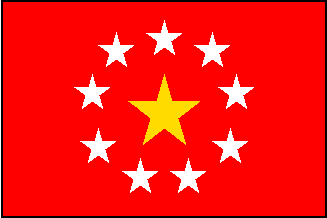
|
| Contrary to popular belief, the Yannists are NOT Utani communists. The Yannists are
hiers to the Isolationist policies of the Utani tribes, supporting the continuation of life
without the benefits of corporatist capitalism or modernisation of the country. The Yannist
movement developed in the late 70's as a response to certain pro-Development initiatives of
the provincial governments and the Tsarist regime. The isolationists are notorious for having
destroyed oil exploration infrastructure off the Guwimith Island coast, and kidnapped
Whitlamite and Zartanian citizens, prompting the invasion by those states, and subsequent
collapse of the very regime that was slowest to modernise the country. The Yannists, and
perhaps with some justification, deny involvement, citing the Yellow Bay rebels, but the
Yannists and the Yellow Bay rebellion were close allies.
Today, the Yannist party continues to support and promote the "alternative way" of non-capitalism, of non-modernisation, and the utopian agrarian society that Utani people have known for centuries. To their credit, they have attracted many Uta-Decashi, too, who want to drop-out of modern society. Their leader is lead-Ramal chief Robert Ramali. |
| A new party formed out of the newly established green movement in Utania. The
greens believe that Vexillium has been damaged to the point of irreversablity by pollution
and other industrial and capitalist activities, and call for a secession of such activities
before determining the sustainable level of such activities. New and inexperienced,
the greens have few fixed policies save the radical statement above. They seek
greater government funding for education of the populace, funding for "green projects",
and further research into the ecology of the earth. They are the only party prepared to
vote themselves out of existence, provided the people understand and act on the need for an
immediate end to industrial and commercial activities.
A radical environmentalist party lead by Dawn K'njosa (cousin to the B'yantusu Chief). |
