
|
Issue 20,
Volume 7, 9 October 300 AP The Story behind the news. |
|
Economics
And now the real work begins... Election 300 Election results The Wisdom of Solomon Politics Governor Hope returns?! International Death of Morania's President Sport Utania's Vexgames bid Football: Is Luka Central unbeatable? |
|
Subscribe to Zeitgeist
Subscriber queries |
|
What IS a Zeitgeist?
Jerman for "Spirit of the Age". In this case it is to mean the "spirit" of the Utanian people, the magazine reporting the people's thoughts behind the press-releases and reported news. |
|
Election 300 Results
No clear winner? We think not - the Peoples-Utani Sædaj coalition storms to the lead in a tight election, making for a somewhat stable government, depending on the centre parties and their allegiances.
This leaves Edward Hope's six-party possible coalition in the cold, with only a maximum of sixty-seven seats in the Parliament.
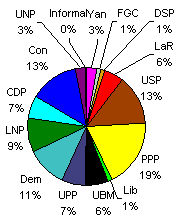
* July 1 poll conducted by Luka Herald newspaper based on 137 MP's and excluding many minor parties. For a complete list of all MP's, click this line Yet according to the last Kapur-Zeitgeist poll conducted just before the election, the PPP-USP coalition were to only hold a maximum sixty-seven seats - what changed? The key is five seats that changed hands: Utan-Nystos in Nystonia state, which was marginally in the PPP's favour, but not too well; And Savaj electorate, where the USP stole a seat off the Progressive Party. (The Peoples Party gained the nett two seats because it took a seat from the USP in Virana electorate.); Plus one seat gained by the Democratic Socialists in the Luka electorate of Okarvits (named after the late, great leader, and father of the likely incoming President); And, finally the Republican Party gained a seat in the electorate of Uraja in Utan Krysaror, taking it from the Conservatives. These four seats, changed the coalition from 67 to 71. Other changes compared to the most recent Kapur-Zeitgeist poll include the loss of three seats by the Progressive Party, the loss of EIGHT seats by the Democrats, but the gain of four seats by both the Conservative and Liberal Nationalist Parties. All wins and losses are marginal, with, in some cases, only a few thousand votes securing the win, but the trend appears to have been brought on by a slight shift in votes to these two parties. The Liberal Nationalists gained a full percentage point support compared with the KZG poll. So, now the likely government will be one of the PPP-USP plus Republicans and the lone Democratic Socialist. This government is likely to then elect Peoples Party leader and former Governor of Utani B'yan (formerly "Horn of Olives" province) George Okarvits, son of the late Abraham, who started the Peoples Party in the 70's, to be the country's first democratically elected President! Though not directly-elected, he is elected by the representatives of the people, the Parliament. He will then face his own Presidential election in the beginning of 302 AP. President Okarvits has wasted no time in establishing the line his administration will take, and though he has stopped short of announcing cabinet positions, saying that he takes nothing for granted, he is clearly expecting to be elected. One seat stability? However, questions are bing raised about the stability of his government. It would take a single MP defection to the opposition to bring Parliament to a halt, and two MP's to bring his government down. The lead is, at best, tenuous. Already cracks may be showing with rumours reporting that "Cruis-Democrat" faction members of the Peoples party being decidedly uncomfortable with the Democratic Socialist MP John Stirling's demands. (The Peoples Party has some four unofficial "factions" within it: right-wing Cruis-Democrats, centrist "Cruistian Liberals", leftist Cruistian-Socialists and "Unity" faction.) However, things need not be so bleak. Rumours abound of the more flexible and moderate parties on the right, the Burovians and Progressives, wanting talks with Okarvits regarding their party's possibly joining the coalition. Angorit's Progressive Party already has some experience with this in Savana state, joining the Peoples Party in opposition. Both parties have also expressed their desire to "ensure" stable government, signalling their refusal to join former-Prime Minister Kemp's opposition coalition, currently made up of the Conservatives, Cruistian-Democrats and Democrats. Boornal is also on record as saying his party would "make our vote count wherever it is most effective for the people of Utania." (See September 25 edition.) Therefore, with only 42 MP's in a confirmed opposition, 71 in government, that leaves at least 17 in the middle, prepared to support government bills on a case-by-case basis. (The other ten seats belong to the Liberal Nationalists who have not decided yet whether to join the opposition or not.) The Burovians are well-known to support liberal-minded social reforms, including land reform, while the Progressive Party are keen supporters of tempered development without destroying Utani culture. There also remains the possibility that one or both "lingering" party joins the coalition in government, possibly removing the need for Okarvits to curry quite so much favour with the difficult Mr Stirling (DSP). This will be good for the country, for a coalition government without a clear lead could fail, and bring the "house" down. The noted political analyst and figure, Professor David Kapur, is particularly pleased with the possible inclusion of the Progressive Party or Burovians in the government, for the same reasons. "Without such additional secured support, President Okarvits may find governing impossible without consulting the crucial parties, including right-wing MP's in his own party." |

|
Readers should be aware that the link between the polls and the actual number of seats won
is calculated based on an excel spreadsheet. The poll results for each of the parties for
each electorate, based on one polled voter per 10,000 voters, are entered into the spreadsheet
and added up for each state then nationally, providing the pie graph of percentage support
for each party. This spreadsheet can be made available to other political bodies after this
election simply by sending an email to the author: david.kapur@zeitgeist.com.ut
Each electorate's MP seat winners is calculated using the method laid out at the UEC site. In short, calculating winners is based on largest number of votes: In three MP Virana, the USP won 38%, the Peoples won 22%, Progressives won 20% and the Democrats 4%. Provided the top winner doesn't have double the support of the third place-party, the top three parties get to send one MP each. If the USP had won 41%, or the Progressives only won 18%, then, because the USP has double the support of the Progressives, it gets to send a second MP to Parliament, before the Progressives get to send any. This then demonstrates how marginal the winning of seats can be. |

|
©Zeitgeist Magazine, 300 AP.
<TECH> ©Mike Ham, 2000. All rights reserved. No reproduction without, at least, tacit approval. ;-) |