
UTANIA ROVENS BUSINESS POLITICS TECHNOLOGY SPORTS ENTERTAINMENT MAGAZINE |
| Subscription |
|
Subscribing Utania this Week Contributions |
| Zeitgeist News |
|
Zeigeist Corporation Zeitgeist News is a wholly owned subsidiary of the Zeitgeist Corporation. |
| Other links |
|
Jagged Blue |
 |
Monday, July 30, 301 AP
Web posted at 2019 UST.
President K'yonte's regime is so unpopular that over one million people have gathered in the capital, Haastadt, to protest his continuing government.
The centre of the capital of Rovens was awash with people today. They had come from as far afield as the Guwimithian cities of the north, such as Kotovsk, and Yoma-Koj in the west. The trains were specially running today expressly for the purpose of ferrying people from around the country into the capital, and never have they worked so efficiently and effectively.
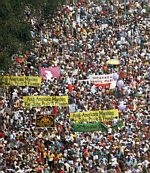 As they arrived at Haastadt Railway Station, organisers were forming massive crowds of
people, then sent them marching and shouting into the city centre, each by a different
route. In all, organisers said they had over a hundred such crowds of people of between five
and ten thousand people. They were then joined by locals who travelled by car to the city,
and joined these organised protests. All were shouting the same thing in a single chorus,
and would sychronise their shouts with another nearby protest crowd if they came close
enough to them. It was like a chorus -- a disharmonious singing of two simple words "K'yonte
resign".
As they arrived at Haastadt Railway Station, organisers were forming massive crowds of
people, then sent them marching and shouting into the city centre, each by a different
route. In all, organisers said they had over a hundred such crowds of people of between five
and ten thousand people. They were then joined by locals who travelled by car to the city,
and joined these organised protests. All were shouting the same thing in a single chorus,
and would sychronise their shouts with another nearby protest crowd if they came close
enough to them. It was like a chorus -- a disharmonious singing of two simple words "K'yonte
resign".
Police admitted from the start: they were helpless to stop them, helpless to stop the organisers, though they did attempt to arrest some of the organisers earlier in the day, only to find the crowd of thousands bear down on them menacingly. Two police vans were set alight and the prisoners were promptly released, to the cheers of the crowd. From that moment on, Haastadt Police Chief Harald Voorsmier, who had so bravely defended the President from the attempted coup, announced a new policy -- prevent bloodshed, save the injured, and prevent dehydration.
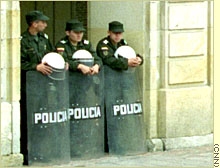 Dehydration was certainly uppermost on the minds of the organisers. Haastadt sits only a few
hundred kilometres from the equator and even during the winter soars to high humidity over
30 degrees. Organisers cranked open water hydrants and provided water for drinking all over
the city. Police at first hindered, but later helped the process, spraying protesters with
police water cannons in the main city square -- though in this case, the hoses were aimed
at the sky, with a light spray, not the usual high powered.
Dehydration was certainly uppermost on the minds of the organisers. Haastadt sits only a few
hundred kilometres from the equator and even during the winter soars to high humidity over
30 degrees. Organisers cranked open water hydrants and provided water for drinking all over
the city. Police at first hindered, but later helped the process, spraying protesters with
police water cannons in the main city square -- though in this case, the hoses were aimed
at the sky, with a light spray, not the usual high powered.
Rallying speeches
The gathering crowds had one objective: 2pm in the city centre, and there was no way they could all fit in. Waving banners and shouting simultaneously "K'yonte resign", the gathering crowd brought the city to a standstill.
At 2pm, it was a rapid succession of speakers all of whom called for the same thing -- an end to violence, justice for assassinated communist Rhosei Penyassa, and for the President to resign. The biggest cheers came for the Communist leader Piers G'nossa, a former member of the PIMR government, now the leader of the absent-from-Parliament Pataki Communist Party, as well as effective leader of Pataki Communist state for which Penyassa was Foreign Minister.
He spoke of the failure of the K'yonte regime to deliver results for the people of Rovens, of the failure to protect the people from political violence by the Army, and of the government's failure to begin the reforms it promised at the year's beginning.
"How much longer will we wait for a real commitment to reform?" G'nossa asked. "How much longer before we see the supposed results of all this hard work by the President? How long does he expect us to wait?" The crowd roared its approval.
Parliamentary moves
Meanwhile, inside the Parliament, which was hastily being recalled, the machinations had begun. K'yonte couldn't obviously continue, said opposition figures and dissident PIMR government members, but who could replace him? Matthias K'yonte, a leading member of the Democratic Freedom Alliance Party, a core party in Roven's governing PIMR coalition was chosen because he was not a threat to the communists, nor to the Army. He was a moderate leftist, with a moderate and concilliatory approach. Perhaps the country needed much more, a stronger hand. Perhaps the Parliament needed to throw the doors open and allow the free election of a new President?
Many favoured the latter approach, and a flurry of candidates came to the fore. Colonel Deniska Nazdratenko, of the right-wing Liberal Party, a front for the Armed forces. Zoran Yefetov from the Loyal Nationalist Party, the pro-Guwimithians would be his deputy. From the more moderate right-wing Democratic Union Party, Armande Dupont, with deputy Charles Van Hooven. Even PIMR allies the Democratic Reform Party are putting forward Johann Wiessman as their candidate. Clearly, the PIMR are unlikely to propose K'yonte again, but the dissidents?
Amea Kope, successor?
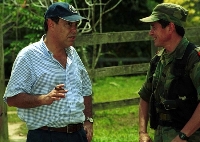 Apparently talk is that Amea Kope is the likely candidate. K'yonte's military man
got on well with the communists who regarded him as "respectful and pragmatic", an advocate
of the "one country, two systems" solution, and a man strong enough to keep the military in
line. Kope had served in Gvonjian-based unit in the Dependencies Defence Forces. However,
he is also considered "too close" to the President, and "not close enough" to the military
to keep them sufficiently in line. Still, he is likely to receive a nomination, and what he
does with it will be up to him.
Apparently talk is that Amea Kope is the likely candidate. K'yonte's military man
got on well with the communists who regarded him as "respectful and pragmatic", an advocate
of the "one country, two systems" solution, and a man strong enough to keep the military in
line. Kope had served in Gvonjian-based unit in the Dependencies Defence Forces. However,
he is also considered "too close" to the President, and "not close enough" to the military
to keep them sufficiently in line. Still, he is likely to receive a nomination, and what he
does with it will be up to him.
By the end of the day, the crowds had somewhat dissipated, but it seems that even through the night a good quarter million intend to continue the protests in the capital, camping out in the city sqauare. The organisers have been busily coopting food warehouses to provide masses of food for the thousands, albeit at a price.
It seems no matter how quickly the President wants it over with, this revolution is here to stay.
Related Stories
Is Rovens falling apart?
Riots break out in Rovens
An interview with Amea Kope
| Related Articles |
|
Rovens Parliament appoints President |
| Other News |
|
Peacekeepers in Dignania |

|
©Zeitgeist Magazine, 300 AP.
<TECH> ©Mike Ham, 2000. All rights reserved. No reproduction without, at least, tacit approval. ;-) |