
UTANIA ROVENS BUSINESS POLITICS TECHNOLOGY SPORTS ENTERTAINMENT MAGAZINE |
| Subscription |
|
Subscribing Utania this Week Contributions |
| Zeitgeist News |
|
Zeigeist Corporation Zeitgeist News is a wholly owned subsidiary of the Zeitgeist Corporation. |
| Other links |
|
Jagged Blue |
 |
Friday, July 20, 301 AP
Web posted at 2239 UST.
HAASTADT, Rovens (RIM) -- The streets are filled with angry young men and women who are pouring their anger out in public at the assassination of popular and much-loved communist Rhosei Penyassa. Rioting has ensued with the Army and government being blamed for the assasination of the country's most beloved communist leader.
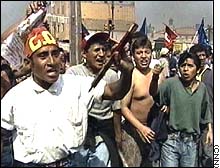 Protests broke out on Thursday night in the Communist capital of Pataki after news
of the assasination broke, and these were followed the next day by protests in all major
cities by youths and workers, many bearing communist banners in Basala-Pataki, the language
of the native Pataki people.
Protests broke out on Thursday night in the Communist capital of Pataki after news
of the assasination broke, and these were followed the next day by protests in all major
cities by youths and workers, many bearing communist banners in Basala-Pataki, the language
of the native Pataki people.
But, what began as a protest has quickly turned to violence, first in T'jomapai, the Pataki-dominated city in the country's centre, then Kopara in the Gvonj region, and finally Haastadt, the national capital before spreading to other cities.
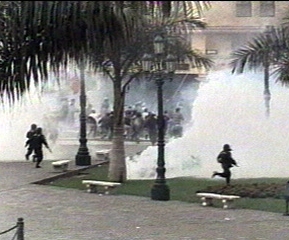
President K'yonte called out the riot Police in force, with water cannons and tear gas in seven cities across the country, to disperse the rioters, but it appeared to inflame their anger as the day turned to night.
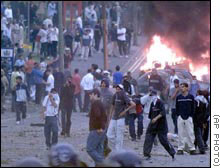 In T'jomapai, over a thousand police assembled in the city centre to face down over
six thousand rioting youths throwing molotov cocktails and bricks. Police injuries are said
to exceed four dozen, while they have only managed to arrest eighteen rioters.
In T'jomapai, over a thousand police assembled in the city centre to face down over
six thousand rioting youths throwing molotov cocktails and bricks. Police injuries are said
to exceed four dozen, while they have only managed to arrest eighteen rioters.
"We find it to be inexcuseable that the people of this country have engaged in lawlessness and rioting in these trying circumstances. I focus the attention of the people on the ring leaders who have chosen to make this public outpouring of grief into a march for violence and lack of control." The President made this announcement on Friday night on the country's only television station, but it does not appear to have moved the rioters.
Frustration
In interviews field reporters have had with rioting youths, there appears to be less bereavement as a comprehensive lack of faith in the K'yonte government to solve the real problems of the country, and singularly blame the government for its failure to protect opposition politicians.
"Penyassa was the voice of the people", said one young man brandishing a wooden club in the city of Kopara, "He stood up for the rights of the people and was determined that this government work for the people, and not the interests of the Tsarists and the army." He said he believed that it was every youth's obligation to "make the voice of the people known tonight!"
 "I am not a communist", said one man holding an unlit molotov-cocktail, "But Penyassa
was speaking about the failure of the government to really change this country, and he was
killed by the army and the government for speaking out." The youth, speaking in Basala-Pataki
admitted he was very angry at not being able to find employment, and that Guwimithians are
getting a better deal than he is. He was later witnessed throwing the then-lit molotov into
police lines before a baton charge began.
"I am not a communist", said one man holding an unlit molotov-cocktail, "But Penyassa
was speaking about the failure of the government to really change this country, and he was
killed by the army and the government for speaking out." The youth, speaking in Basala-Pataki
admitted he was very angry at not being able to find employment, and that Guwimithians are
getting a better deal than he is. He was later witnessed throwing the then-lit molotov into
police lines before a baton charge began.
It appears that the rioting is the venting of months-if-not-years of swallowed frustration at the poverty, the influence of the army, the lack of political will in Haastadt, and the record levels of unemployment that are said to be in excess of 40% for youths.
Popular
Despite the frustrations of political stagnation fueling the riots, there is no denying that the die-hard communist, and former rebel commander was highly regarded as a man who had brought solutions to the Pataki people in the city of Patak and its surrounds.
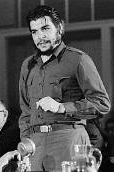 He had been a brilliant tactical, guerrilla commander in the communist rebel army he joined
in the late seventies, and, as the rebels' lead communist political philosopher, lead the
Pataki Peoples Army reconstruction project in the mid-eighties. This project, an eight-year
strategy for building a communist state in the middle of the rebel-held territory, with free
health services, worker-committees in factories and farms, universal free education, was
enormously popular and provided the Pataki people with a sense of achievement they had not
felt in hundreds of years of Guwimithian rule.
He had been a brilliant tactical, guerrilla commander in the communist rebel army he joined
in the late seventies, and, as the rebels' lead communist political philosopher, lead the
Pataki Peoples Army reconstruction project in the mid-eighties. This project, an eight-year
strategy for building a communist state in the middle of the rebel-held territory, with free
health services, worker-committees in factories and farms, universal free education, was
enormously popular and provided the Pataki people with a sense of achievement they had not
felt in hundreds of years of Guwimithian rule.
This achievement made him the most popular communist leader in the Pataki Communist State. He became deputy Party secretary, and Industry minister in the fledgeling rebel government. In the mid-90s, he moved from development of the rebel nation, to maintaining contacts with the outside world, as the rebel state's Foreign Minister, a provocative position because it effectively declared the rebel state's international legitimacy, if only amongst other communists. The Guwimithian government put a multi-million Ruble contract on his head.
Because of his outlaw appeal, his youthful looks, and his key role in the development of the modern communist state of the Pataki people, Penyassa had enormous appeal amongst Pataki, Begrali and Gvonjian peoples outside the rebel state. He was seen by many, even non-communists, as the "man most likely" to provide stability and peace to Rovens.
His assassination kills those hopes, and has provoked this violent outpouring of a mixture of grief and disgust.
Opposition to reintegration
Having built the rebel state, and negotiated with the outside world for legitimacy, Penyassa was understandably one of the strongest critics of attempts to negotiate a truce and the reintegration of the communist state into Rovens-proper. He lead a strong contingent of hard-line communists in the Pataki Peoples Party organisation opposed to anything short of "one-nation, two-systems" with the Rovens government.
It is because of this opposition that many believe the K'yonte government orchestrated his assassination. With Penyassa out of the way, the path would be clear for Piers K'nossa and other moderate communists to negotiate the final resolution. However, having served with Penyassa for over twenty years, regardless of any disagreement he had with Penyassa, the communist party secretary, K'nossa, had no choice than to denounce the assassination as "political terrorism" and order an emergency party conference to consider the party's response.
Regardless of the result, Rovens has been plunged into a political crisis from which it may never recover. Certainly President K'yonte's authority has been undermined, and the mortal political blow may come from the Pataki communists he has done his best to woo.
Related Stories
Thousand march in support of communist regime
Rovens attempted-coup ends
Military coup attempt in Rovens capital

|
©Zeitgeist Magazine, 300 AP.
<TECH> ©Mike Ham, 2000. All rights reserved. No reproduction without, at least, tacit approval. ;-) |